

Why Choosing the Right Desk or Workstation Is an Important Ergonomic Choice
Table of Contents
- Why Is the Desk Choice an Ergonomic Decision, Not Just a Furniture Decision?
- Single-Tier vs Dual-Tier: The Distinction Most Buyers Don’t Know They’re Making
- How Do You Choose the Right Ergonomic Workstation? A Decision Guide
- What Makes AFC Industries’ Ergonomic Workstation Range Different?
- Using the AFC Industries Configurators
| QUICK ANSWER —Choosing the right ergonomic workstation desk requires matching three variables: your specific task type (keyboard-heavy vs. screen-reference-heavy), whether you need a single working surface or independent keyboard and monitor heights (single-tier vs. dual-tier), and the height adjustment range that covers your seated and standing elbow heights. The Cochrane Collaboration’s systematic review confirms that height-adjustable sit-stand desks reduce lower back pain and sitting time versus standard desks. AFC Industries’ ergonomic workstation range — from the Whitestone Workstation for clinical and high-attention reading environments to the Single Tier for standard office sit-stand use — covers every configuration with matching configurators for custom specifications. |
Most people choose a desk the way they choose office chairs: based on how it looks, what it costs, and whether it fits in the space. The ergonomic dimension — how the desk configuration affects posture, fatigue, and the quality of the work done at it — gets considered after the purchase, if at all, usually when something starts hurting.
This is a costly sequence. The physical configuration of your workstation determines your posture for every hour you work at it. A desk at the wrong height, with a monitor at the wrong position, is a cumulative load on your spine and musculature that compounds across every working day. The Cochrane Collaboration’s systematic review found that sit-stand desks produce meaningful reductions in lower back pain compared to standard desks. NIOSH ergonomics data links correct workstation configuration to reductions in musculoskeletal disorders of 40–60% in office environments.
Choosing the right desk is not a comfort preference. It is an ergonomic decision with measurable health and performance consequences. This article gives you the framework to make it correctly — and maps the decision to the AFC Industries workstation range so that choosing becomes straightforward rather than overwhelming.
Why Is the Desk Choice an Ergonomic Decision, Not Just a Furniture Decision?
The desk is the physical foundation of your working posture. Get the height wrong and every other ergonomic intervention — the chair adjustment, the monitor arm, the keyboard tray — is fighting against the baseline. Get it right and those other elements fall into place around it.
The primary ergonomic variable in desk selection is height adjustability. A fixed-height desk sets one working height for all tasks and all users. For the specific person whose elbow height at seated working posture happens to match that fixed height, it is correct. For everyone else, it is a compromise that generates the wrist extension, neck flexion, or shoulder elevation that becomes the afternoon ache or the chronic RSI.
A height-adjustable desk allows seated and standing working heights to both be correct for each individual user. The sitting height positions the keyboard at elbow height. The standing height positions the keyboard at standing elbow height. The transition between them is position variation — the single most research-supported intervention for reducing sedentary posture accumulation. The Cochrane systematic review, the NIOSH occupational health data, and the clinical ergonomics research all converge on the same conclusion: the height-adjustable desk is the right foundational choice for any full-time desk worker.
The secondary ergonomic variable is tier configuration: whether the desk has a single working surface at one height, or a dual-tier configuration with independent keyboard and monitor levels. This distinction is less well known and more important than most buyers realise.
For the detailed research case for height-adjustable workstations, including the Cochrane Review and OSHA data, see the AFC Industries guide on whether height-adjustable workstations are worth it.
Single-Tier vs Dual-Tier: The Distinction Most Buyers Don’t Know They’re Making
A single-tier desk has one surface. Both keyboard and monitor sit at the same height. This means one of them is at the wrong position for most users: either the monitor is at keyboard height (too low — causing neck flexion) or the desk is raised to put the monitor at eye level (keyboard now too high — causing wrist extension).
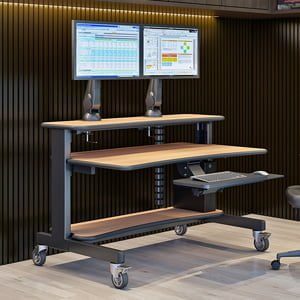
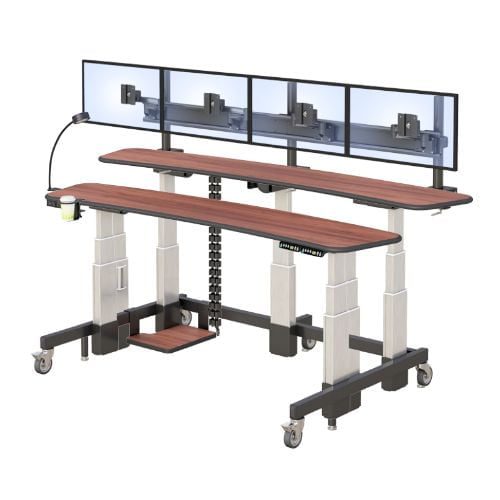
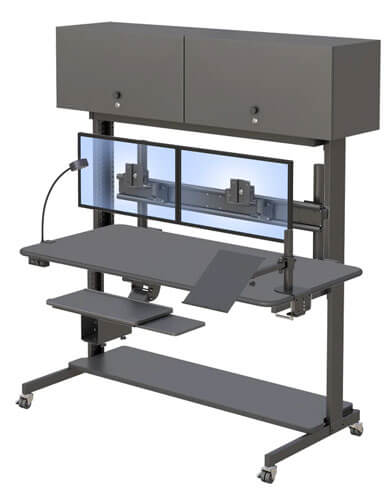
A dual-tier desk has two levels: a lower surface for the keyboard at elbow height, and a raised tier for the monitor at eye level. Both positions are simultaneously correct. The keyboard does not constrain the monitor height. The monitor position does not constrain the keyboard height.
Who needs dual-tier: anyone who spends the majority of their working day using both keyboard and screen simultaneously — writers, analysts, programmers, data workers, and — critically — radiologists and diagnostic imaging readers who use PACS workstations with multiple monitors over long reading sessions. For these users, the single-tier compromise generates the neck and wrist load that accumulates as the defining end-of-day discomfort of desk work.
For the full dual-tier vs single-tier analysis, see the AFC Industries dedicated guide: why use a dual-tier desk over a single-tier desk.
How Do You Choose the Right Ergonomic Workstation? A Decision Guide
The table below maps six common situations to the right AFC Industries workstation configuration and explains the reasoning. Most buyers will find their situation in one of these rows.
| Your Situation | Best For | AFC Industries Recommendation + Why |
|---|---|---|
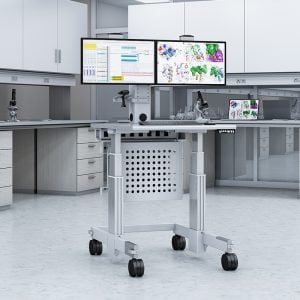
| I need a full-featured height-adjustable workstation with radiology-grade stability | All-day keyboard + screen user; radiology, imaging, diagnostics | Whitestone Workstation — full height adjustment range, multi-monitor capacity, engineered for sustained diagnostic reading sessions |
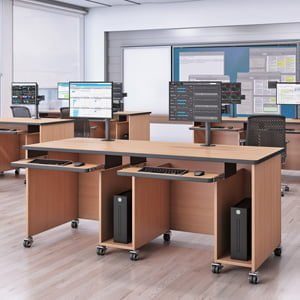
| I want a dual-tier setup with keyboard below monitor | Sustained keyboard + screen work; developer, analyst, writer, data entry | Deluxe Ergo Tier — independent keyboard and monitor tier heights; eliminates the keyboard/monitor height conflict |
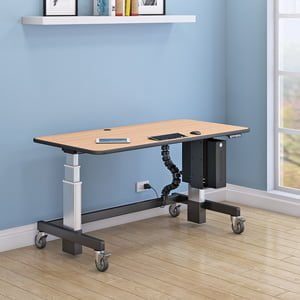
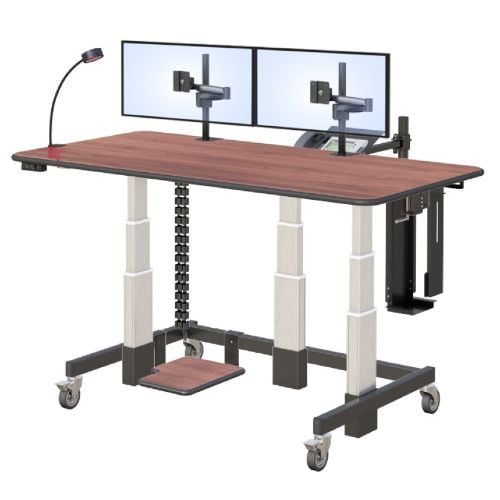
| I need a standard ergonomic sit-stand desk with good adjustability | General office use; full-day keyboard work; hot-desk environment | Ergo Tier — height-adjustable, clean modern profile, suitable for single or dual monitor |
| I need a dual-tier with more compact footprint | Limited desk real estate; dual monitors needed without full-size dual-tier surface | Dual Tier Desks — more compact than Deluxe Ergo Tier; still provides independent keyboard and screen levels |
| I need a single-surface sit-stand desk | Light screen reference work; primary keyboard user with occasional screen; budget-aware | Single Tier — clean sit-stand functionality without the dual-tier complexity; good for general office environments |
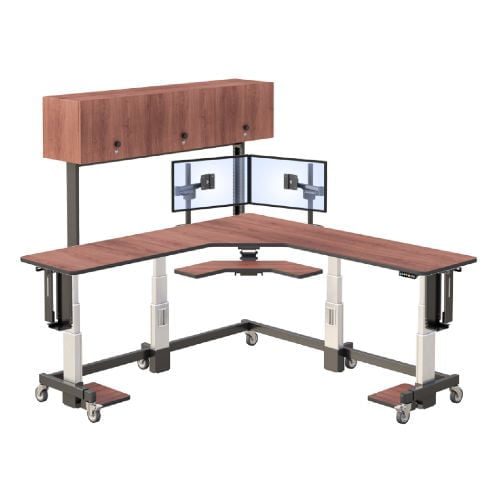
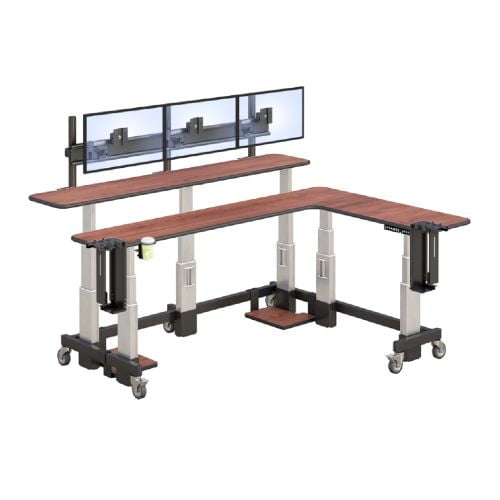
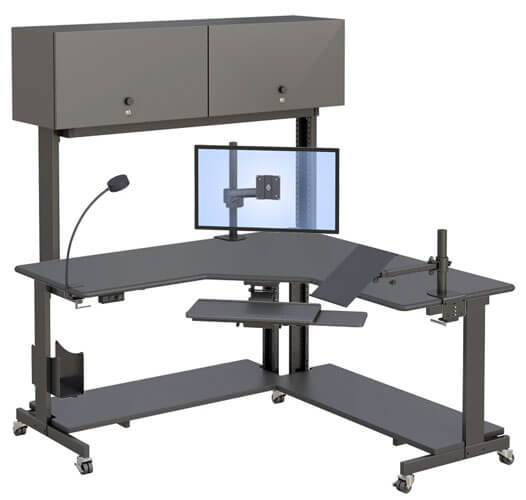
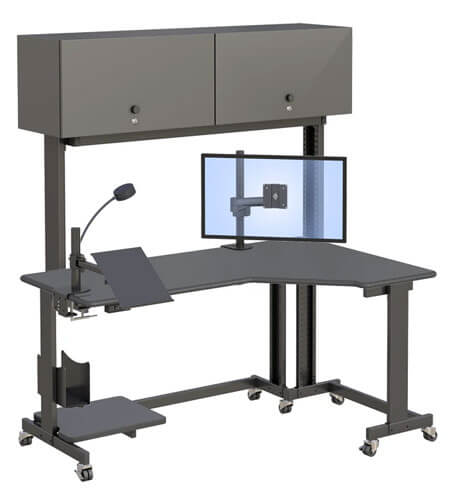
| I need a corner or L-shaped ergonomic setup | Multiple monitors; large document + screen reference workflows; control room setups | Single Tier Corner Desk or Bi-Level Corner Desk — via configurators |
Two configurations deserve particular attention:
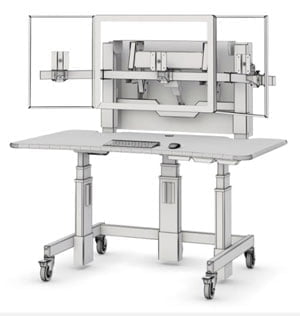
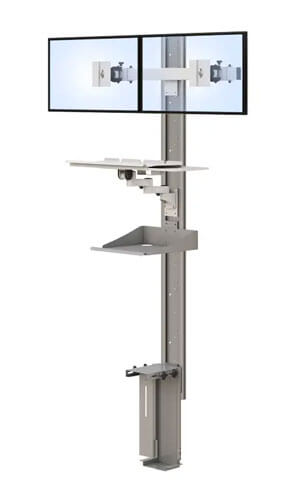
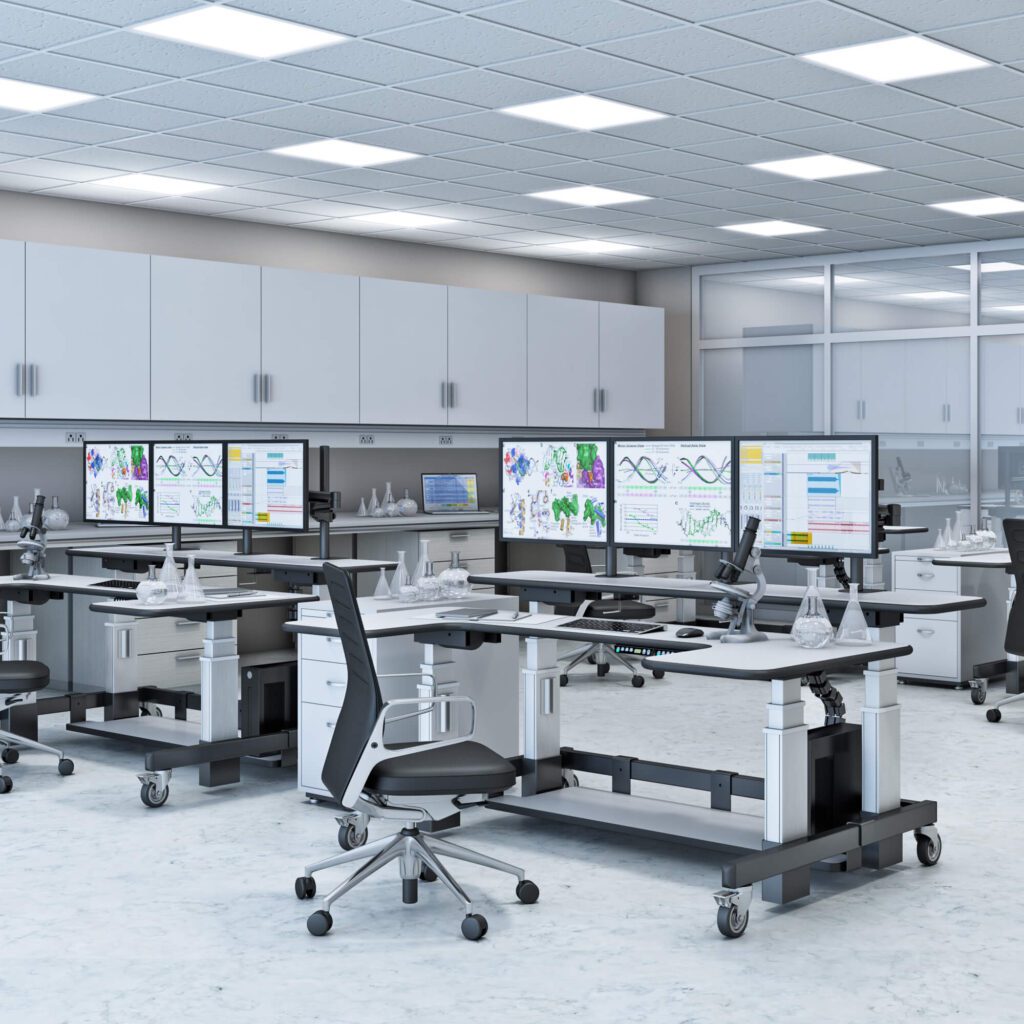
- The Whitestone Workstation is AFC Industries’ flagship ergonomic workstation — designed for environments where the quality of sustained work directly depends on physical configuration quality. Radiology reading rooms, PACS workstations, and high-attention analytical environments. It covers the full seated-to-standing height range, supports multi-monitor loads with stability, and is built to the specification that sustained precision work requires.
- The Deluxe Ergo Tier is the dual-tier solution for full-day keyboard-and-screen workers. Its independent keyboard and monitor tiers eliminate the height conflict that single-tier desks impose, making it the right choice for anyone who experiences neck or upper back tension from their current desk setup.
What Makes AFC Industries’ Ergonomic Workstation Range Different?
AFC Industries’ ergonomic workstation range covers more of the decision space than most standing desk suppliers. The range spans from the general office sit-stand to the clinically-specified radiology workstation, and each configuration is available through a set of configurators that allow buyers to specify dimensions, finishes, and features before purchase rather than selecting from fixed configurations.
| AFC INDUSTRIES ERGONOMIC WORKSTATION RANGE OVERVIEW
Whitestone Workstation — Flagship height-adjustable workstation for high-attention environments including radiology, PACS reading, and sustained precision work. Full height range, multi-monitor stability, clinical-grade specification. Deluxe Ergo Tier — Dual-tier height-adjustable workstation with independent keyboard and monitor levels. The right choice for full-day keyboard-and-screen workers experiencing neck or wrist tension from a single-tier setup. Ergo Tier — Standard height-adjustable sit-stand desk with clean ergonomic profile. Suitable for general office use, single or dual monitor, and hot-desk environments. Dual Tier Desks — Compact dual-tier configuration for workspaces where footprint is limited but independent keyboard/monitor heights are needed. Single Tier — Clean, efficient sit-stand desk for general office use where a single surface configuration is appropriate. Radiology Office Workstation — Specifically designed for diagnostic radiology reading rooms with DICOM-grade display positioning, multi-monitor stability, and the ergonomic specification that sustained reading sessions require. |
Using the AFC Industries Configurators
AFC Industries provides interactive configurators that allow buyers to specify their exact desk dimensions, finishes, and features before purchase. Rather than selecting from a fixed catalogue, you start from your space measurements and working requirements and build the specification from there.
- Single Tier Configurator — for single-surface height-adjustable desk configurations
- Dual Tier Configurator — for dual-tier keyboard/monitor separation configurations
- Single Tier Corner Desk Configurator — for L-shaped single-tier setups
- Bi-Level Corner Desk Configurator — for dual-tier corner configurations
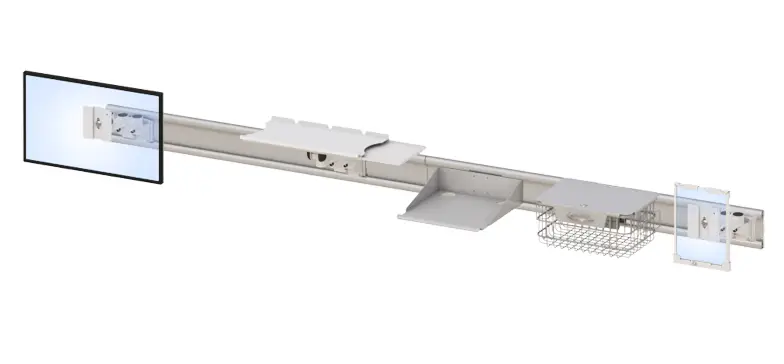
- Vertical Configurator — for vertical workspace configurations
- Horizontal Configurator — for wide horizontal workspace configurations
If you know your working pattern and space constraints but aren’t sure which configuration is right, contact AFC Industries to discuss the right desk specification for your environment. Alternatively, browse the full standing desk range or the complete all standing desks overview.