

Why Buy Ergonomic Laboratory Furniture? The Complete Guide for Lab Managers and Facilities Teams
Table of Contents
- Why Are Ergonomics Especially Important in Laboratory Environments?
- What Is the Dual Constraint That Lab Furniture Must Solve?
- AFC Industries Ergonomic Lab Furniture: Options by Lab Type
- What Specific Features Should Ergonomic Lab Furniture Include?
- How to Specify Lab Furniture for Your Environment
| QUICK ANSWER — Ergonomic laboratory furniture reduces musculoskeletal injury risk, improves precision task performance, and — unlike generic ergonomic office furniture — simultaneously meets the contamination control, chemical resistance, and cleanroom compliance requirements of laboratory environments. Laboratory operators performing precision tasks over long shifts at fixed-height benches accumulate the same cumulative postural load documented in office workers, but at higher intensity because lab tasks require sustained concentration and fine motor control. AFC Industries’ laboratory furniture range includes cleanroom carts, tech lab workstations, wet lab carts, lab carts, and cleanroom workbenches matched to ISO 14644-1 classification requirements for pharmaceutical, semiconductor, clinical, and research laboratory environments. |
Laboratory work is physically demanding in ways that are less visible than manufacturing or construction, but no less consequential. A pharmaceutical chemist pipetting at a fixed-height bench for six hours, a semiconductor technician performing wafer inspection in a cleanroom ISO 6 environment, a clinical lab analyst processing samples at a pathology station — each is performing precision, repetitive tasks over long shifts in a posture that standard lab furniture doesn’t accommodate for their specific height or working position.
The ergonomic case for laboratory furniture is also a compliance case. OSHA’s Laboratory Safety guidelines identify ergonomic hazards — repetitive motion, awkward postures, sustained static work — as among the most significant injury risks in laboratory environments. The Bureau of Labor Statistics consistently identifies laboratory occupations among the worker groups with elevated rates of musculoskeletal disorders.
What makes laboratory furniture specification more complex than general office ergonomics is the dual constraint: lab furniture must solve the ergonomic problem and the contamination control problem simultaneously. A standard height-adjustable office desk is not cleanroom-compatible. A standard stainless-steel lab bench is not ergonomically adjustable. AFC Industries’ laboratory cart and workstation range addresses both requirements from the specification stage rather than forcing a compromise between them.
Why Are Ergonomics Especially Important in Laboratory Environments?
Laboratory work concentrates the ergonomic risk factors that cause musculoskeletal disorders in ways that standard office work does not. Three characteristics of lab tasks make this worse than the office context:
First, precision tasks amplify postural constraint. A lab analyst pipetting, a pathologist examining slides, an electronics technician inspecting circuit boards under magnification — all require the operator to hold a precise postural position for the duration of the task. Unlike general office work, where there is some natural movement between tasks, precision laboratory work requires sustained stillness that generates high cumulative static load in the relevant muscle groups.
Second, shift length and task repetition. Laboratory shifts of 8–12 hours are common in clinical, pharmaceutical, and industrial laboratory settings. Performing the same postural pattern repeatedly across a shift of that length generates cumulative musculoskeletal load that a correctly specified workstation can significantly reduce. A bench at the wrong height is not a minor inconvenience — it is a load multiplier across every repetition of every task for every hour of the shift.
Third, the consequences of fatigue extend beyond the operator. In precision analytical work, fatigue affects accuracy. An analyst who is managing physical discomfort in the later part of a shift is allocating cognitive resources to that discomfort rather than to the task. In pharmaceutical quality control, diagnostic pathology, and semiconductor inspection, the accuracy consequence of operator fatigue is a quality outcome, not just a welfare one.
OSHA’s laboratory safety guidelines cover ergonomic hazard identification and control in laboratory environments. The National Institute for Occupational Safety and Health (NIOSH) provides additional guidance on ergonomic risk factors in scientific and laboratory occupations.
What Is the Dual Constraint That Laboratory Furniture Must Solve?
Standard ergonomic office furniture — height-adjustable desks, ergonomic chairs, monitor arms — is designed for office environments. It addresses posture and adjustment range, but its surface materials, caster types, and construction are not rated for laboratory cleaning agents, controlled environment particle requirements, or chemical exposure. Deploy a standard height-adjustable office desk in a pharmaceutical cleanroom and it fails the contamination control qualification. Its surfaces may off-gas in ISO-classified environments. Its casters shed particles. Its frame has recesses that trap contamination.
Standard laboratory benches solve the contamination control problem and ignore the ergonomic one. Fixed-height stainless steel or epoxy resin benches meet the surface and cleaning requirements, but they are configured to a single height that is correct for one operator and a compromise for everyone else.
AFC Industries’ laboratory furniture range is engineered from specification for both constraints: adjustable surfaces in materials appropriate to the lab classification, with casters, fasteners, and construction details that meet the contamination control requirements of the target environment. The specification decision is not ‘ergonomics or compliance’ — it is ‘which configuration satisfies both for this specific lab type.’
AFC Industries Ergonomic Lab Furniture: Options by Lab Type
The right ergonomic lab furniture depends on the specific laboratory environment, its contamination control classification, the cleaning agents used, and the tasks being performed. The table below maps five common lab types to their key surface requirements, the relevant AFC Industries product, and the critical specification decision for each.
| Lab Type | Key Surface Requirement | AFC Industries Product | Critical Specification |
|---|---|---|---|
| Cleanroom (ISO 5–8) | Non-outgassing, no particle traps, ESD-safe options | Cleanroom Carts, Tech Lab Cleanroom Carts | Sealed construction; ISO-rated casters; chemical-resistant surfaces |
| Wet lab | Corrosion resistance, easy drainage, chemical splash tolerance | Wet Lab Cleanroom Cart | Chemical-resistant polypropylene or epoxy resin surfaces; sealed electronics |
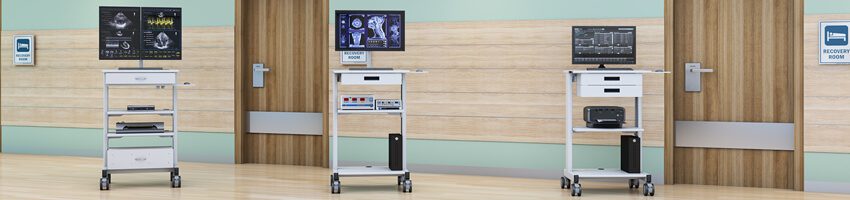
| Pathology / clinical lab | Antimicrobial surfaces; cleanable; compliant with disinfection protocols | Lab Cart (Medical Carts range) | Hospital-grade surface materials; compatible with quaternary ammonium and sporicidal agents |
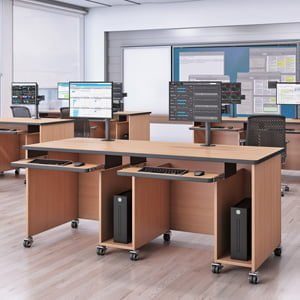
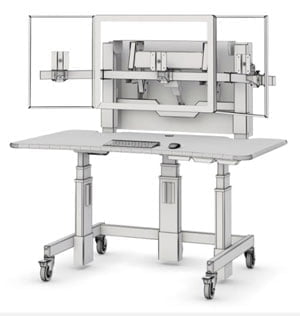
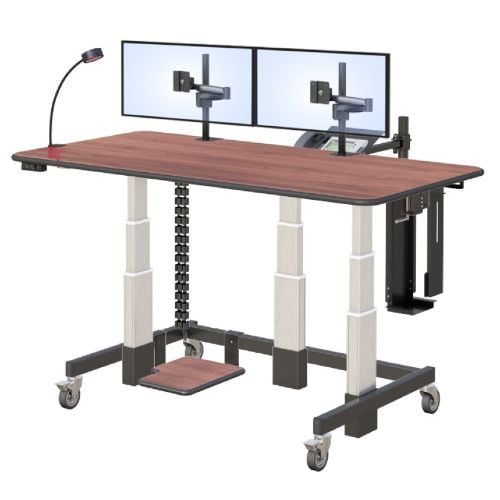
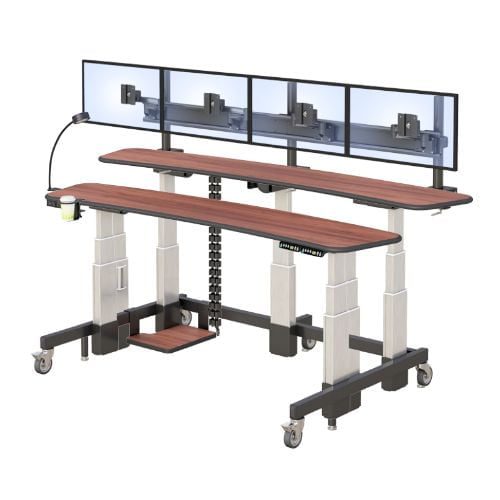
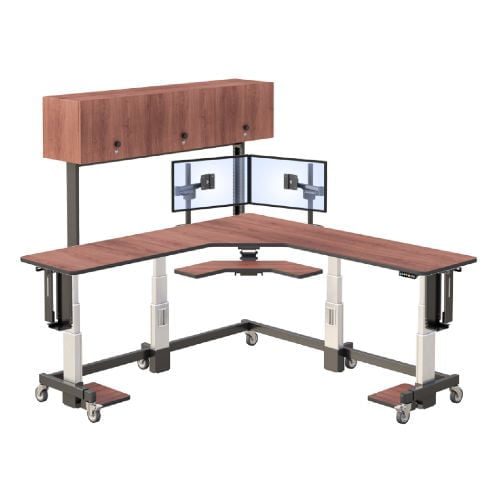
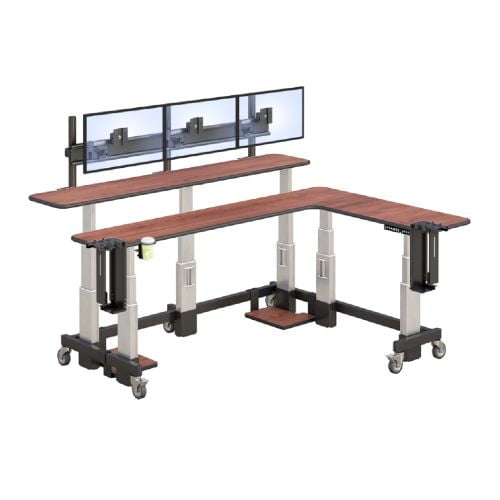
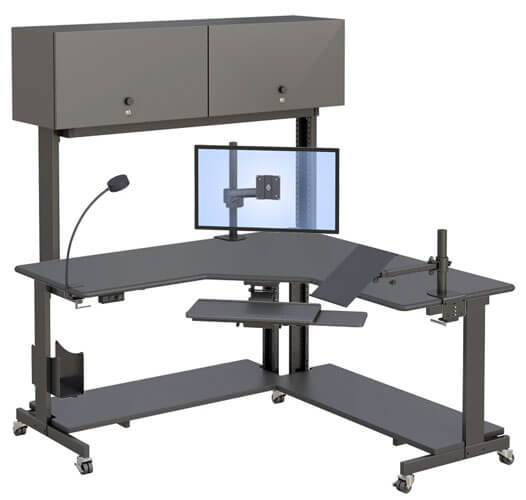
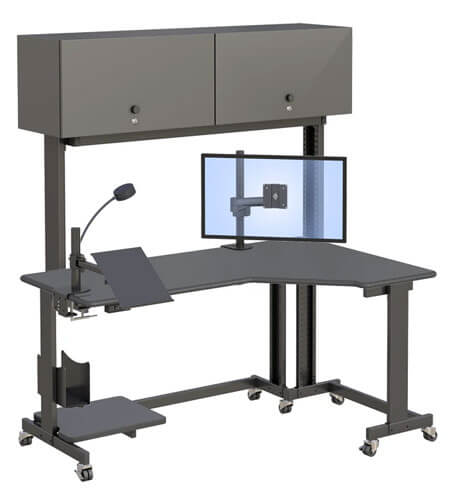
| General laboratory | Ergonomic height adjustment; surface durability; mobility | Workbench; Lab Cart | Height-adjustable work surface for standing or seated use; heavy-duty frame |
| Electronics / tech lab | ESD compliance; anti-static surfaces; grounded casters | Tech Lab Cleanroom Carts | ANSI/ESD S20.20 compliant; dissipative surface; conductive casters |
Two product lines deserve additional detail:
- Tech Lab Cleanroom Carts are designed for electronics manufacturing, semiconductor fabrication, and MEMS production environments where ESD compliance is as important as ISO classification. Conductive casters, dissipative work surfaces, and grounding provisions meet ANSI/ESD S20.20 alongside the contamination control requirements of ISO-classified environments.
- Wet Lab Cleanroom Carts address the chemical exposure requirements of pharmaceutical synthesis, biotech research, and analytical chemistry environments. Chemical-resistant polypropylene or epoxy resin surfaces, sealed electronics, and corrosion-resistant frames accommodate the specific cleaning agents and chemical splashes common in wet lab settings.
What Specific Features Should Ergonomic Lab Furniture Include?
Beyond the lab-type surface and caster specifications, five features determine whether ergonomic lab furniture delivers its benefit in practice:
| ERGONOMIC LAB FURNITURE SPECIFICATION CHECKLIST
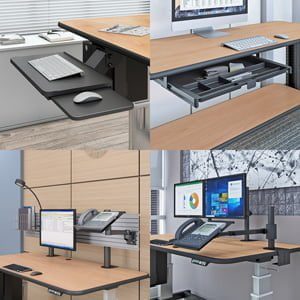
Height adjustment range covering seated and standing elbow heights. For the full operator population in the lab. Seated elbow height for most adults is 65–75cm; standing elbow height is 95–115cm. Lab furniture whose range doesn’t cover both extremes for the actual operator population defaults to a fixed-height compromise. Surface material compatibility with cleaning agents. List every cleaning agent, disinfectant, and chemical used on the lab bench or cart surface. Obtain written confirmation from the manufacturer that the surface material is compatible with each specific agent. Incompatible surfaces degrade within months and create contamination risk from surface degradation. Cleanroom caster specification. For ISO-classified environments, casters must have sealed bearings to prevent particle generation, and the caster compound must be compatible with the cleanroom floor surface and cleaning agents. Verify caster bearing seals are documented as cleanroom-appropriate. ESD compliance where required. For electronics and semiconductor lab environments, verify ANSI/ESD S20.20 compliance for surfaces and casters. ESD-safe surfaces, conductive casters, and grounding provisions are all required for full compliance. Cable management for lab instrument integration. Modern laboratory workstations connect to multiple instruments, computers, and monitoring systems. Internal cable management channels that allow height adjustment without disconnecting instrument connections are a practical requirement in any lab with electronic instrumentation. |
For AFC Industries’ full laboratory and cleanroom furniture range, browse cleanroom carts, cleanroom workbenches, and the lab cart for clinical and general laboratory environments. Use the workbench page for height-adjustable bench configurations suitable for general and industrial laboratory settings.
How to Start the Specification Conversation
Ergonomic lab furniture specification starts with three questions: What is the ISO classification or contamination control standard for the environment? What cleaning agents are used and what surface compatibility do they require? What are the seated and standing elbow heights of the operator population? The answers to those three questions determine the surface specification, the caster specification, and the height adjustment range required — and from there, the right product configuration.
AFC Industries builds laboratory furniture from specification for pharmaceutical, semiconductor, clinical, electronics, and general research environments. The product range covers standard configurations and custom OEM builds for environments where standard products don’t meet the specific compliance or workflow requirements.
Contact AFC Industries to discuss your laboratory environment’s specific requirements, or browse the full cleanroom product range and all lab and medical cart options to explore configurations for your lab type.