
Why Are Healthcare Professionals Turning to Remote Telemedicine Carts for Patient Communications?
Table of Contents
- Why Are Healthcare Professionals Adopting Telemedicine Carts?
- What Clinical Use Cases Do Telemedicine Carts Enable?
- Why Does Physical Cart Specification Determine Whether Telemedicine Works?
- What Does a Correctly Specified Clinical Telemedicine Cart Include?
- AFC Industries Telehealth Cart Configurations
| QUICK ANSWER —Healthcare professionals are adopting remote telemedicine carts to bridge the specialist access gap between patients and providers separated by geography, to deliver remote monitoring and consultation without requiring patient travel, and to make permanent the telehealth workflows that proved clinically viable during the COVID-19 pandemic. A telemedicine cart provides the stable, battery-powered, clinically configured mobile platform that connects a patient at a bedside, community clinic, or home to a specialist over a video consultation. AFC Industries’ telehealth cart range covers configurations from compact telehealth pole carts for community nursing to full Point Of Care PC Carts for ward-based telemedicine programmes. |
The specialist is in Boston. The patient is in rural Vermont. The condition needs expert assessment today, not after a six-hour round trip that an elderly patient cannot make. A telemedicine cart at the community hospital puts the specialist’s face at the patient’s bedside via video, with the clinical interface the specialist needs to review records, conduct an examination, and make a management decision. The patient doesn’t travel. The specialist doesn’t travel. The care happens.
This is what remote telemedicine carts do at their most consequential: they close the specialist access gap that rural and underserved healthcare populations experience as a matter of geography. The Health Resources and Services Administration (HRSA) documents persistent shortages of specialist physicians in rural Health Professional Shortage Areas across the United States. Telemedicine addresses this shortage not by moving specialists to rural areas but by moving specialist-quality consultation to patients wherever they are. The cart is the physical infrastructure that makes that possible.
Beyond rural access, telemedicine carts are now part of routine clinical workflows in urban hospitals, intensive care units, community-based outpatient clinics, and home nursing programmes. The COVID-19 pandemic accelerated adoption that was already underway and demonstrated at scale that telemedicine could deliver clinical outcomes comparable to in-person consultation for a wide range of conditions. What it also demonstrated is that the quality of the physical cart infrastructure was a significant determinant of whether those outcomes were achievable in practice.
Why Are Healthcare Professionals Adopting Telemedicine Carts?
Three structural drivers are converging to make telemedicine cart adoption a standard capital investment for healthcare facilities rather than a pilot programme consideration:
- The specialist shortage and rural access gap. HRSA’s Health Professional Shortage Area designations cover a substantial proportion of rural US counties for primary care, dental, and mental health specialties. For subspecialties — neurology, cardiology, dermatology, psychiatry — the gap is wider still. Telemedicine carts allow community hospitals and rural health clinics to provide specialist consultation access without staffing specialists on site. The cart is what brings the specialist to the patient room.
- Permanent CMS telehealth reimbursement expansion. The Centers for Medicare and Medicaid Services expanded telehealth reimbursement during the pandemic and subsequently made many of those expansions permanent or extended them through ongoing legislation. Telehealth services that were previously unreimbursable or restricted to originating site rules are now consistently reimbursable, which changes the financial calculus for telehealth infrastructure investment. A telemedicine cart is now a capital asset with a documented revenue-generating application, not just a technology experiment.
- Post-pandemic normalisation of telehealth in clinical workflows. McKinsey’s consumer health data and JAMA research both documented telehealth adoption surges during the pandemic that have partially but not fully reversed. Patients who experienced telehealth consultations have demonstrated willingness to continue using them for appropriate care types. Health systems that built telehealth capability during the pandemic are now investing in making it sustainable — which means replacing emergency-grade deployments with correctly specified clinical infrastructure.
For more on how post-pandemic telehealth infrastructure is evolving, see AFC Industries’ article on why healthcare professionals are turning towards telehealth workstations and the AFC Industries telehealth product range.
What Clinical Use Cases Do Telemedicine Carts Enable?
Telemedicine carts serve different clinical workflows with different specification requirements. The table below maps six common use cases to their clinical context and the cart specification requirement that each demands. Most healthcare facilities have more than one of these use cases active simultaneously.
| Use Case | Clinical Context | Cart Specification Requirement |
|---|---|---|
| Specialist consultation | Patient in community hospital or CBOC needs remote specialist — neurologist, cardiologist, dermatologist | Cart at patient bedside with stable camera at clinician eye level; EHR access for the consulting specialist to review records during call |
| Remote patient monitoring | Chronic condition patient at home or rural clinic needs regular clinical video check-in | Compact pole cart or tablet cart; battery for home environment without reliable wall power; camera angle for patient-facing consultation |
| ICU / critical care tele-ICU | Intensivist monitors multiple ICU beds remotely; cart is the patient-side interface | Full workstation cart; high-resolution camera; audio peripheral for clear communication; stable base for critical care environment |
| Mental health consultation | Patient in rural or underserved area needs behavioural health access via video | Privacy-appropriate camera angle; neutral cart background; audio quality for sensitive conversation; stable positioning |
| Surgical pre/post consultation | Surgeon reviews patient remotely for pre-op assessment or post-op follow-up | Height-adjustable cart for clinician comfort during extended review; EHR integration; camera that shows the relevant anatomical area clearly |
| Home nursing telehealth | Community nurse conducts video consultation from patient’s home | Lightweight, vehicle-portable; battery-powered; domestic-space maneuverability; camera stable without tripod |
Two use cases deserve additional emphasis:
- Tele-ICU. The tele-ICU model — a remote intensivist monitoring multiple ICU beds simultaneously via a centralised telehealth platform — is one of the most resource-efficient applications of clinical telemedicine. The cart at the patient bedside is the intensivist’s eyes and ears in rooms they are not physically present in. The specification requirements for this use case are among the most demanding: camera resolution, audio quality, and platform stability must all be clinical-grade because the consultation decisions being made are critical-care decisions.
- Community-based outpatient clinics (CBOCs) and rural health clinics. For the VA healthcare system and rural federally qualified health centers (FQHCs), the telemedicine cart at a CBOC is often the primary mechanism for specialist access. A patient who cannot travel to a major medical center for neurology, cardiology, or psychiatry can receive that consultation at their local CBOC via a telemedicine cart. For these settings, battery power and lightweight maneuverability are important because CBOC infrastructure is often more limited than major hospital facilities.
Why Does Physical Cart Specification Determine Whether Telemedicine Works?
There is a version of the telehealth story that treats the physical infrastructure as an afterthought — any cart with a tablet holder will do. This version of the story is inconsistent with two years of pandemic-era telehealth deployment experience, which produced a clear and consistent set of physical infrastructure failure modes:
- Battery failure mid-consultation. A telemedicine session that drops because the cart battery ran out before the end of the clinical encounter is not a software failure. It is a battery specification failure. A specialist consultation interrupted by a power failure requires a callback that may not happen for hours, and the clinical continuity loss is a patient safety issue in time-sensitive conditions.
- Camera instability. A camera platform that shakes when someone touches the cart, or that cannot hold a stable angle during patient examination, degrades the video quality that clinical assessment depends on. Dermatology consultations, wound assessments, and neurological examinations conducted over video are only clinically valid when the image quality is adequate.
- Incorrect height configuration. A cart set at a fixed height that places the camera at chest level rather than face level, or that requires the clinician to crouch to use the interface, is providing a consultation experience that is worse than necessary for both the patient and the provider.
- Surface incompatibility with disinfection. Telemedicine carts in clinical environments are cleaned between patients. A cart surface that degrades under the facility’s standard disinfection protocol becomes a contamination risk within months of deployment. This was a documented failure mode in many pandemic-era rapid deployments.
For the full six-point telemedicine cart specification checklist developed from HIMSS 2022 deployment experience, see AFC Industries’ guide to telehealth cart specification.
What Does a Correctly Specified Clinical Telemedicine Cart Include?
| SIX SPECIFICATION REQUIREMENTS FOR A CLINICAL TELEMEDICINE CART
1. Stable camera platform at clinician and patient eye level. The camera must be positionable at the correct height for the clinical interaction — face-level for consultation, examination-area level for wound or physical assessment. The platform must not move during the consultation. 2. Battery capacity for the full clinical session. Map the expected session duration and calculate battery requirement with 20% margin. A 90-minute specialist consultation requires a minimum 2-hour battery. For a full clinic of consecutive consultations, size to the full clinic duration. 3. Height adjustment for the clinical team. The cart must be adjustable across the height range of all clinicians who use it — from seated documentation to standing examination positioning. Electric mechanism with presets is the most practical for multi-clinician environments. 4. Surface material compatible with your disinfection protocol. List every cleaning agent used in the environment and obtain manufacturer confirmation of compatibility. Do not accept ‘wipeable surfaces’ without specifying which agents are compatible and at what concentration. 5. Cable management for professional patient-facing video. The camera view should present a professional clinical environment to the patient. Trailing cables visible on screen communicate disorganisation in a professional consultation context. 6. EHR terminal or tablet integration. The cart should support the clinician’s EHR access during and immediately after the consultation, enabling contemporaneous documentation rather than retrospective entry. |
AFC Industries Telehealth Cart Configurations
- Telehealth Products range — AFC Industries’ full telehealth and telemedicine cart range, covering clinical consultation, remote monitoring, and point-of-care communication configurations.
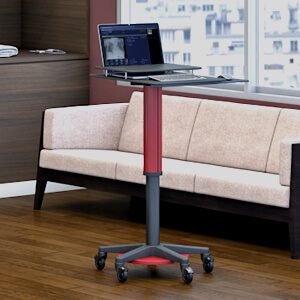
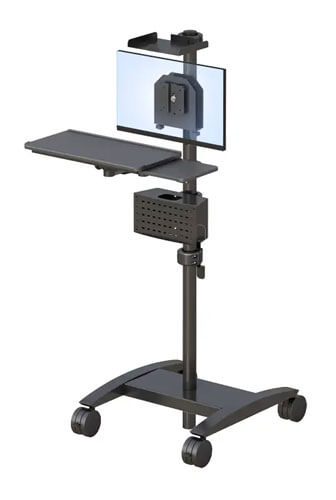
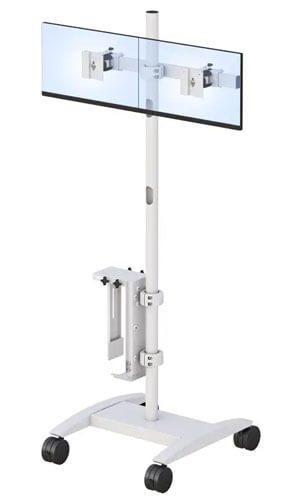
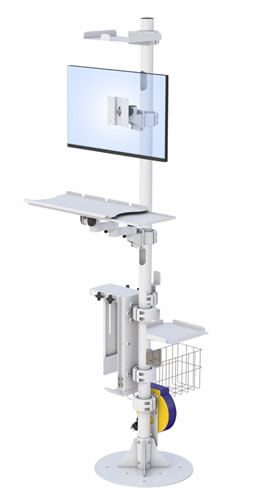
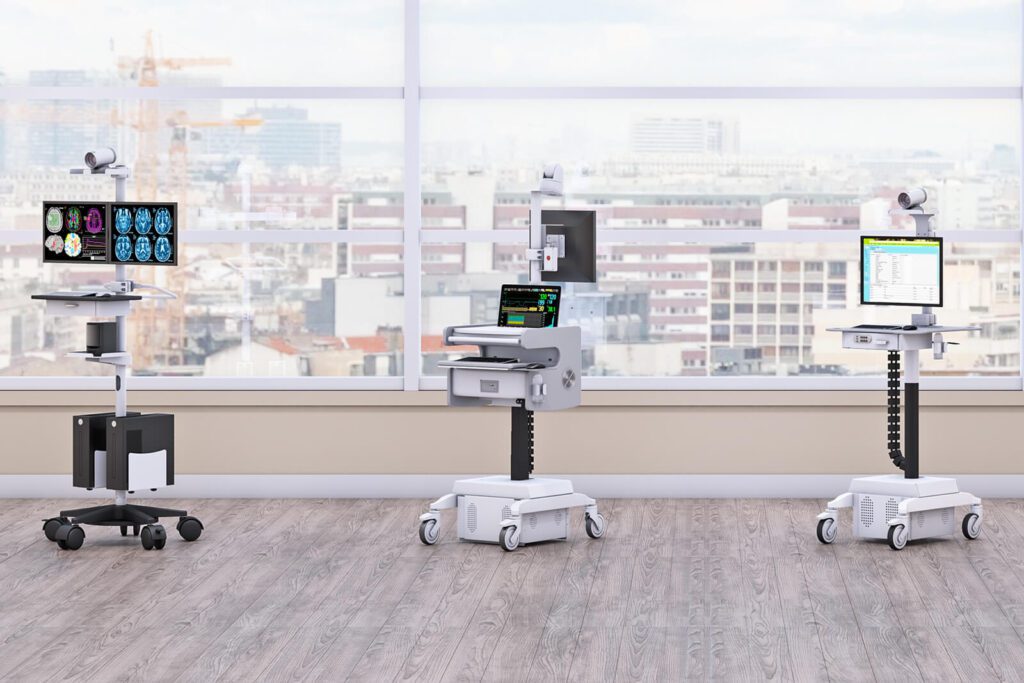
- Telehealth Pole Cart — Compact pole-mounted telehealth cart for tablet-based consultation in community clinics, CBOCs, and home nursing environments. Battery-powered; vehicle-portable; stable camera platform.
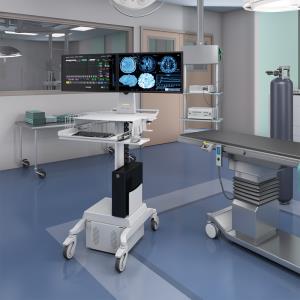
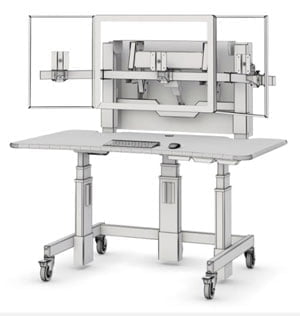
- Point Of Care PC Cart — Full clinical workstation cart for ward-based and ICU telemedicine programmes. EHR integration, height-adjustable platform, clinical-grade surface specification.
- Battery Power Carts — Extended-battery mobile carts for telehealth environments where session-length battery is the primary specification requirement.
Browse AFC Industries’ full telehealth and telemedicine cart range, or contact AFC Industries to discuss the telemedicine cart specification for your facility’s specific clinical programme, reimbursement environment, and infrastructure constraints.