

Why Are Fixed-Height Workstations the Most Efficient Desks in Today’s Office Environments?
Table of Contents
- When Is a Fixed-Height Workstation the Most Efficient Choice?
- Fixed-Height vs Height-Adjustable: A Decision Framework
- If You Choose Fixed-Height, Ergonomic Specification Is More Important
- How to Calculate the Correct Fixed Height for Your User Group
- AFC Industries Fixed-Height and Adjustable Workstation Options
| QUICK ANSWER — Fixed-height workstations are the most efficient desk choice when the workstation is dedicated to a single user, the user population is ergonomically homogeneous, the environment demands structural durability that adjustable mechanisms cannot match, or budget constraints make adjustable deployment impractical at scale. They are not inherently inferior to height-adjustable desks — they are the correct specification in these four defined conditions. When any of these conditions change — particularly when the workstation will be shared by users of different heights — a height-adjustable desk is the correct choice. AFC Industries offers fixed-height solutions through its Workbench and Conference Table ranges, and height-adjustable desks through its full standing desk range. |
The ergonomics conversation in office design has spent a decade making the case for height-adjustable workstations, and that case is well made. For most shared office environments and most multi-user settings, height-adjustable is the right choice. The research supports it. The OSHA guidance points toward it. The Cochrane Review confirms it.
But the conversation has created a secondary misconception: that fixed-height workstations are a compromise, a budget-constrained alternative to what the user really should have. This is not accurate. Fixed-height workstations are the right choice in a set of specific, definable circumstances — and in those circumstances, they are more efficient than their adjustable counterparts, not less.
This article makes the honest case for fixed-height workstations: when they are genuinely the better choice, how to decide between fixed and adjustable, and — critically — how to specify a fixed-height workstation correctly, because getting it wrong is more consequential than getting an adjustable desk wrong.
When Is a Fixed-Height Workstation the Most Efficient Choice?
Four conditions define when fixed-height is the right specification:
- The workstation is dedicated to a single user. A workstation used by one person every working day, for the foreseeable future, needs to be at the correct ergonomic height for that person. Once that height is correctly set and fixed, there is no reason to change it. A height-adjustable mechanism adds cost, mechanical complexity, and potential failure points without providing a benefit when the height doesn’t need to change. The correctly specified fixed-height dedicated workstation is not a compromise — it is the appropriate solution.
- The user population is ergonomically homogeneous. In environments where all users are within a narrow height range — for example, a precision manufacturing environment where the workforce has been selected or trained to work at a specific ergonomic position — a fixed-height workstation set at the ergonomic midpoint of the group serves all users adequately. The adjustment mechanism adds no value because there is no meaningful variation to accommodate.
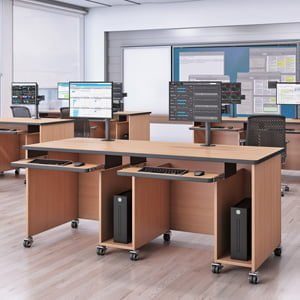
- The environment demands structural durability that adjustable mechanisms can’t match. In industrial environments with vibration, heavy equipment loads, chemical exposure, or extreme temperature variation, height-adjustment mechanisms — particularly electric motors and pneumatic gas springs — degrade faster than fixed-frame construction. A welded or bolted fixed-height workbench in a machine shop or a heavy lab environment will outlast an equivalent adjustable desk by years. In environments where the desk is expected to last 15–20 years under heavy use, fixed-height is the right specification.
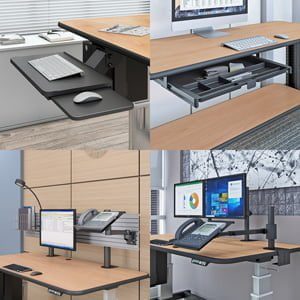
- Budget constraints make adjustable deployment impractical at scale. A height-adjustable desk costs 30–60% more than an equivalent fixed-height desk. For a 10-desk configuration, that difference is manageable. For a 100-desk bulk deployment in a call centre, manufacturing facility, or education environment, the price differential represents a significant capital budget impact. Fixed-height deployed at the correct ergonomic height for the user population, supplemented with monitor arms and keyboard trays where needed, can serve a large population adequately at a lower total cost than adjustable for every position.
For the broader workstation decision framework including when adjustable is the right choice, see why choosing the right desk or workstation is an important ergonomic choice.
Fixed-Height vs Height-Adjustable: A Decision Framework
The table below maps six common workstation scenarios to whether fixed or adjustable is the right choice and explains the reasoning. Most procurement decisions will fall clearly into one category.
| Your Situation | Context | Fixed or Adjustable? Why |
|---|---|---|
| Single dedicated user, never shared | One person uses this workstation every day; their height sets the correct position permanently | Fixed-height — set once at the correct ergonomic height for that user; no mechanism needed |
| Homogeneous height team, same task | All users on this shift are within a 5cm height range and do the same task | Fixed-height at the ergonomic midpoint of the group; no adjustment mechanism adds value |
| High structural load or vibration environment | Heavy equipment, vibration from machinery, or extreme durability requirements | Fixed-height industrial workbench or fixed-frame desk; adjustable mechanisms degrade under vibration |
| Budget-constrained bulk deployment | Fitting out 50+ workstations where cost is the primary constraint | Fixed-height at correctly specified heights per user group; adjustability not cost-justified at this scale |
| Multi-user general office, daily rotation | Different people use the same desk every day with height variation across users | Height-adjustable (Ergo Tier or Single Tier) — fixed-height will be wrong for too many users |
| Clinical shared workstation | Nurses of different heights across shifts | Height-adjustable with memory presets; fixed-height causes documented posture and fatigue issues |
The critical insight from this framework is that the fixed vs adjustable decision is not a quality decision — it is a use-case decision. A fixed-height desk at the correct height for a dedicated single user is a better ergonomic outcome than an adjustable desk that is never adjusted because the user doesn’t know how. And an adjustable desk deployed in a multi-user shared environment is a better ergonomic outcome than a fixed desk that is correct for one shift and wrong for the next.
If You Choose Fixed-Height, Ergonomic Specification Is More Important
There is an irony in fixed-height workstation specification: because the height cannot be changed after installation without replacing the workstation, getting it right at specification stage is more consequential than for an adjustable desk. An adjustable desk deployed at the wrong height can be corrected in 30 seconds. A fixed-height workstation deployed at the wrong height is wrong until it is replaced.
This makes the upfront ergonomic specification of a fixed-height workstation the most important phase of the procurement process. OSHA’s ergonomic workstation guidelines provide the reference heights: the primary work surface should be at elbow height in the user’s normal working posture. For seated work, this is typically 65–75cm from the floor. For standing work at a fixed-height counter, this is typically 95–115cm. These ranges reflect the variation in elbow height across the adult working population, and the correct single height within those ranges depends on the specific user or user group.
The consequence of getting this wrong is not theoretical. A desk set at 75cm for a user whose seated elbow height is 65cm forces 10cm of wrist extension or shoulder elevation for the entire working day, every working day, for the life of the workstation. The musculoskeletal load that generates is exactly what the NIOSH ergonomics research documents as the primary driver of office-work repetitive strain injuries.
NIOSH guidance on computer workstation ergonomics includes the reference elbow heights and monitor positioning standards that correctly specified fixed-height workstations should be built to.
How to Calculate the Correct Fixed Height for Your User Group
For a dedicated single-user workstation: measure the user’s seated elbow height (floor to elbow with feet flat, forearms parallel to floor) and set the fixed height at that measurement. Add a monitor arm to position the display independently at the correct eye level, and a keyboard tray if the surface is too high for neutral wrist position.
For a multi-user group at the same fixed-height workstation: measure the seated elbow height of every person who will regularly use the workstation. Set the fixed height at the 50th percentile of the group. Supplement with monitor arms and keyboard trays for users at the upper and lower extremes of the group. Accept that users outside the middle range will require supplementary adjustments — and document those adjustments as part of the workstation setup for new users.
For standing-height fixed counters: use the same method for standing elbow height. The 50th percentile standing elbow height for the US adult working population is approximately 105cm, but the working range across the full adult population spans roughly 95–115cm. A standing counter set at 105cm will be approximately correct for the majority of users and manageable for most of the rest with anti-fatigue matting.
AFC Industries Fixed-Height and Adjustable Workstation Options
| AFC INDUSTRIES WORKSTATION RANGE: FIXED-HEIGHT AND ADJUSTABLE
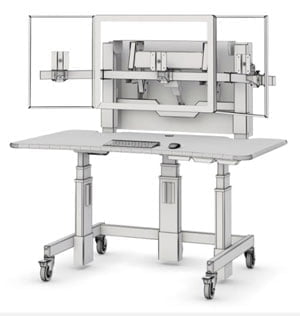
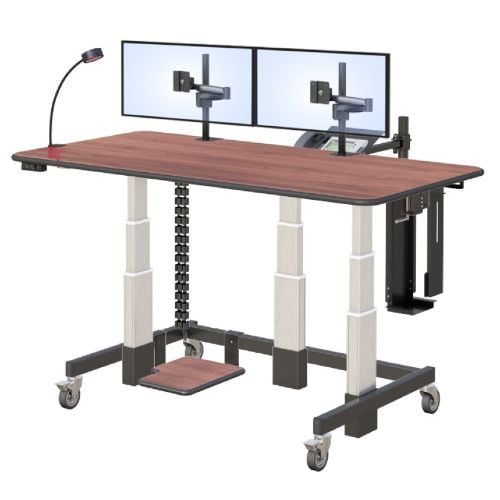
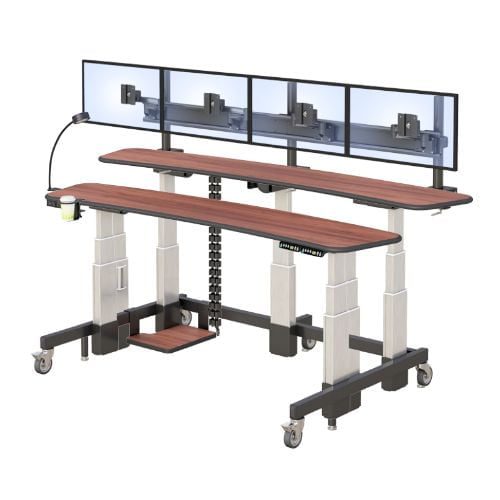
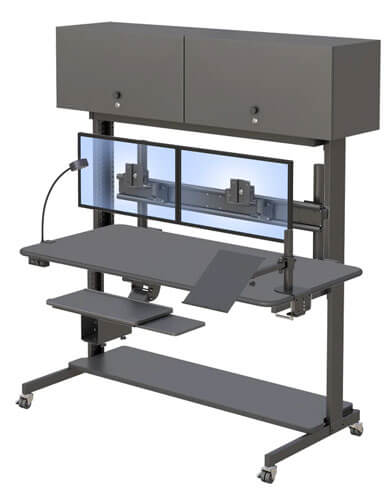
Fixed-height options: Workbench — Fixed-height work surface for laboratory, industrial, and technical environments. Available in configurations suited to heavy-duty use where adjustable mechanisms would be impractical. Conference Tables — Fixed-height meeting and collaboration tables for conference room environments where standard height is appropriate for all users. Height-adjustable alternatives (if re-evaluation leads to adjustable): Ergo Tier — Height-adjustable sit-stand desk for general office use. Can be set at a fixed height for a single user environment while retaining the option to adjust. Single Tier — Standard height-adjustable single-surface desk. Cost-effective entry point for adjustable desk deployment. Deluxe Ergo Tier — Dual-tier height-adjustable for full-day keyboard-and-screen users who need independent keyboard and monitor heights. |
Browse AFC Industries’ full workbench range for fixed-height configurations, and the full standing desk range for height-adjustable alternatives. For guidance on which configuration fits your environment, see why choosing the right desk is an important ergonomic choice or contact AFC Industries directly.