

What Are the Immediate Advantages of a Semi-Circular or U-Shaped Workstation with Single-Tier or Dual-Tier Work Levels?
Table of Contents
- What Does the C or U Shape Actually Give You?
- Why the C-Shape Is the Natural Form for Radiology Reading Rooms
- Single-Tier vs Dual-Tier: Which C/U Shape Configuration Is Right?
- What Other Environments Benefit from Semi-Circular Workstations?
- AFC Industries C-Shape and Corner Workstation Configurations
| QUICK ANSWER — A semi-circular or U-shaped workstation provides three immediate advantages over a standard rectangular desk: (1) everything is within the user’s natural arm reach without rotating the chair, eliminating the repeated trunk rotation that accumulates as fatigue in extended sessions; (2) a wide monitor array can be arranged in a continuous viewing arc, with every display visible without turning; (3) the concave shape reduces the depth of reach required to access material at the desk perimeter, keeping the working posture neutral throughout. A dual-tier C-shaped workstation adds a fourth advantage: the lower tier at elbow height for keyboard and documentation, and the raised tier at eye level for monitors, achieving correct ergonomic positions for both simultaneously. AFC Industries’ Whitestone Workstation and Radiology Office Workstation are purpose-built C-shaped dual-tier configurations for PACS-based diagnostic reading rooms. |
Standard rectangular desks are a reasonable solution for one person working on one thing in one direction. They are a poor solution for anyone who works with multiple screens, reference materials, and peripherals simultaneously — because everything beyond the central working area requires a reach, a lean, or a chair rotation that should not need to happen dozens of times per session.
The semi-circular or C-shaped workstation solves this geometry problem. By wrapping the working surface around the user in a continuous arc, it places every part of the workspace within natural arm reach from a fixed, ergonomically neutral sitting position. No chair rotation. No extended reach to the corner of a rectangular desk. No looking sideways to a monitor that should be in front of you but isn’t because there’s no room for it directly ahead.
For general office users with two or three monitors and a wide reference workflow, this is a productivity and comfort advantage. For radiologists reading diagnostic images across a 3–4 monitor PACS setup for 6–8 hours a day, it is a clinical performance and fatigue management requirement. This article covers the geometry, the single-tier vs dual-tier distinction, the use cases beyond radiology, and AFC Industries’ configurations.
What Does the C or U Shape Actually Give You?
The ergonomic advantage of the C or U shape comes from a single geometric property: the concave arc positions every part of the workspace within the user’s natural arm reach from a fixed sitting position. On a standard rectangular desk that is 180cm wide, reaching the corners requires either a forward lean that puts the torso outside the base of support, or a chair rotation that, repeated over the course of a session, generates cumulative torsional load on the lumbar spine and hip flexors.
The C-shaped desk removes both compromises. The working surface wraps around the user so that the far corners of the desk are at the sides — accessible with a lateral arm reach from a neutral sitting posture, without any forward lean or rotation. For a workstation user whose workflow requires frequent transitions between equipment at different positions — between a primary display, a reference monitor, a keyboard, a secondary input device, and physical documentation — the reach geometry is the difference between a workflow that feels smooth and one that feels like constant physical management.
The multi-monitor benefit follows directly. A 3–4 monitor array arranged across a C-shaped surface sits within the user’s horizontal viewing arc: the primary display straight ahead, secondary displays to either side at natural eye-swivel angles, reference displays at the outer edges of the arc. No display requires a neck turn that takes the cervical spine outside its comfortable range of motion. The entire array is visible from a single neutral head position.
For the research case for ergonomic workstation form and its relationship to sustained performance, see the AFC Industries guide on why choosing the right desk is an important ergonomic choice and the ergonomic improvements and radiologist well-being research summary.
Why the C-Shape Is the Natural Form for Radiology Reading Rooms
Radiology reading room workstation design is a clinical specification, not just an office furniture decision. The American College of Radiology’s Technical Standard for Electronic Practice of Medical Imaging addresses display positioning requirements: the primary diagnostic display must be directly in the reader’s line of sight, at the correct luminance, and at the correct distance for the imaging modality. Secondary and reference displays must be positioned to minimise head and neck rotation.
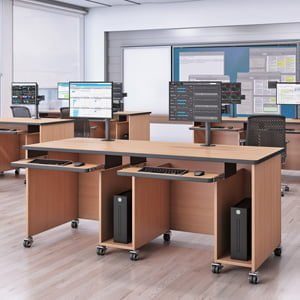
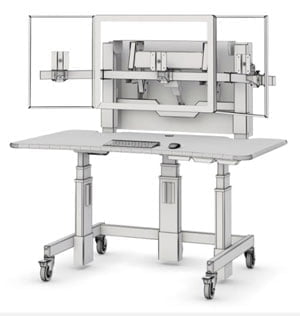
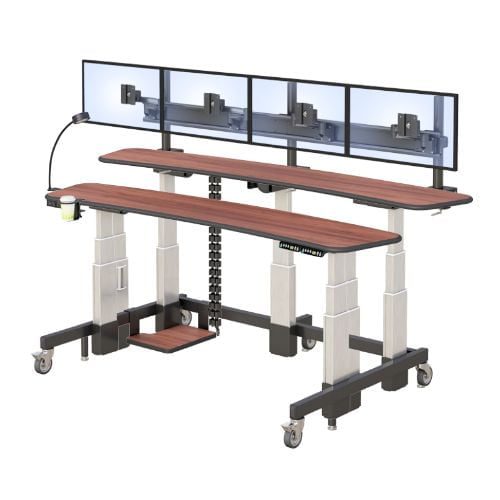
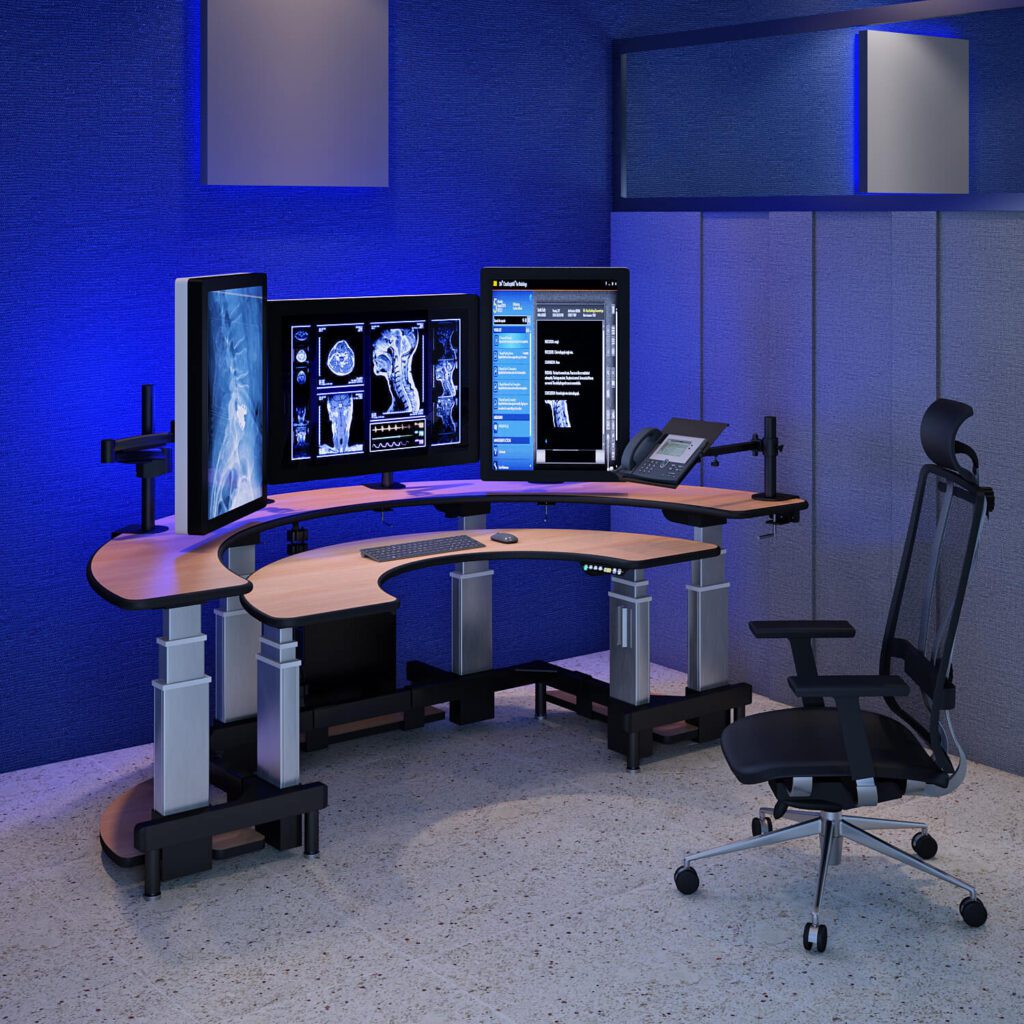
The C-shaped dual-tier workstation satisfies all of these requirements simultaneously. The raised monitor tier on the dual-tier C-shape positions every display at eye level. The concave arc places every display within the natural horizontal viewing arc without neck rotation. The lower tier at elbow height keeps the keyboard and documentation surface at the correct ergonomic position while the monitors are at the correct visual position. For a radiologist reading a full diagnostic session of 100–200 studies, this configuration is the form that allows sustained attention without progressive physical fatigue.
AFC Industries’ Whitestone Workstation and Radiology Office Workstation are both available in C-shaped dual-tier configurations purpose-built for PACS reading environments. For the detailed clinical argument for ergonomic radiology workstations, see the AFC Industries article on radiologist well-being.
Single-Tier vs Dual-Tier: Which C/U Shape Configuration Is Right?
The choice between a single-tier and dual-tier C or U-shaped workstation depends on whether the user’s workflow requires simultaneous keyboard use and screen reference at different ergonomic heights — the same single vs dual-tier question addressed in Blog 4, applied to the C-shape form factor.
| Factor | Single-Tier C/U Shape | Dual-Tier C/U Shape |
|---|---|---|
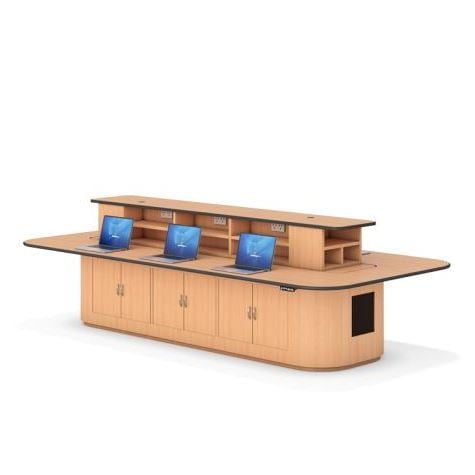
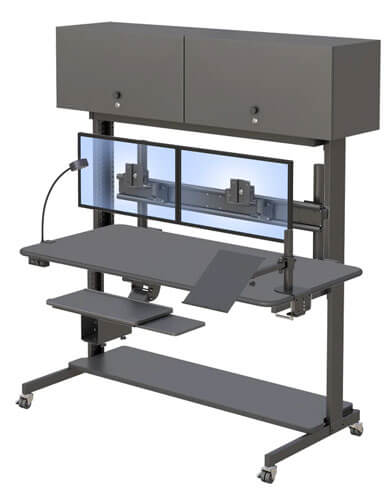
| Surface area | Single continuous working surface in C or U shape | Two working levels: lower keyboard/work surface + raised monitor tier across the full C/U span |
| Ergonomic benefit | Large contiguous surface for documents, reference materials, and peripherals all within reach | Independent keyboard and monitor heights eliminates the height conflict; correct elbow AND eye level simultaneously |
| Multi-monitor support | Monitors sit on the work surface at desk height — ergonomically suboptimal for sustained viewing | Monitors on the raised tier at eye level; keyboard and work surface at elbow level; DICOM-grade positioning for radiology |
| Best workflow | Wide document reference, drawing review, control room multi-display, light reading + documentation | Sustained diagnostic reading (radiology, cardiology, PACS), heavy keyboard + screen workflows, analyst and developer workstations |
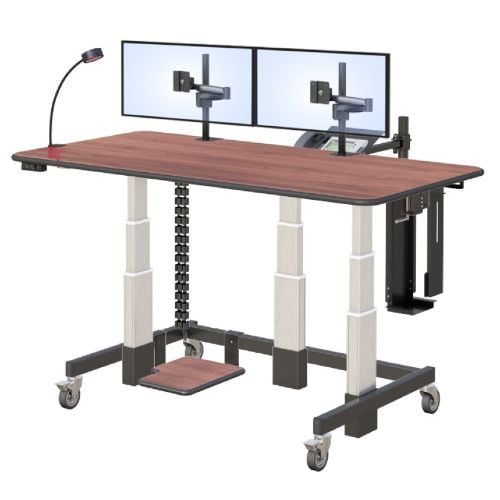
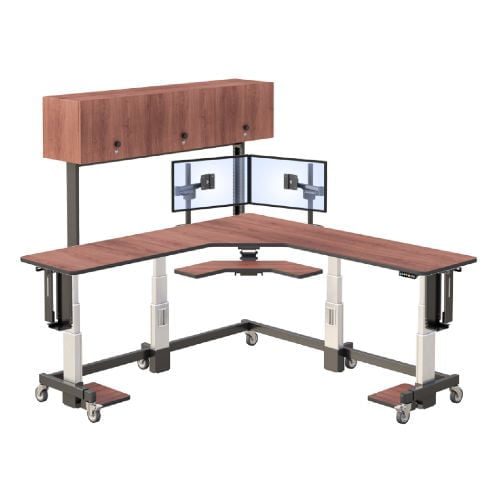
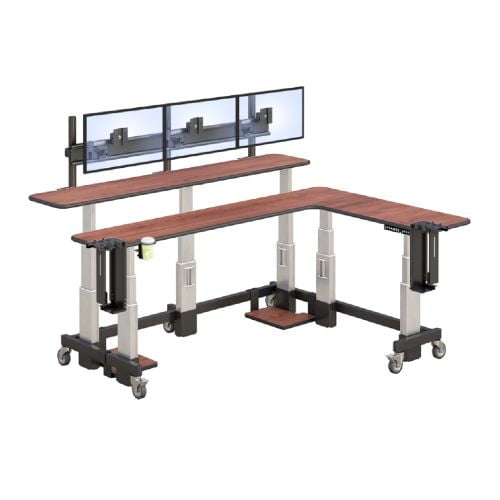
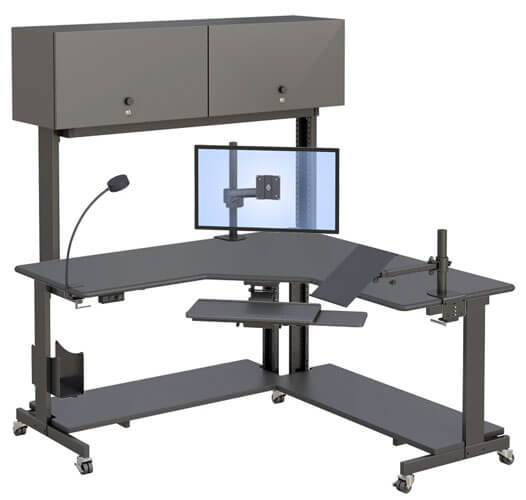
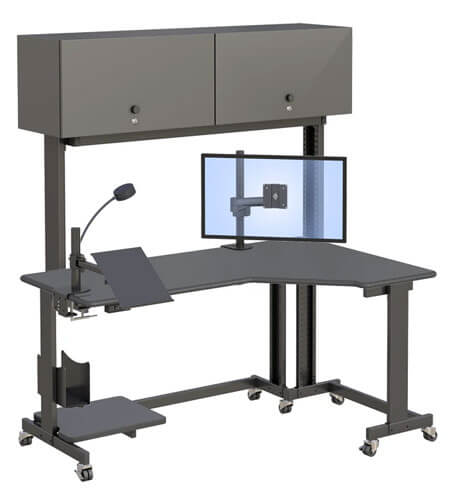
| AFC Products | Single Tier Corner Desk (via Single Tier Corner Desk Configurator) | Bi-Level Corner Desk (via Bi-Level Corner Desk Configurator); Whitestone Workstation; Radiology Office Workstation |
| Footprint | Larger — the full C/U shape requires significant floor area; suitable for dedicated reading rooms | Same C/U footprint with additional vertical height from the raised monitor tier |
The practical decision: if monitors will sit directly on the desk surface, single-tier is appropriate and the concave geometry provides the reach and viewing arc advantages. If monitors need to be at eye level while the keyboard is at elbow height simultaneously — which is the specification for any sustained precision reading environment — the dual-tier C-shape is the correct form.
Both configurations are available through AFC Industries’ online configurators: the Single Tier Corner Desk Configurator for single-tier C/U configurations, and the Bi-Level Corner Desk Configurator for dual-tier corner workstations.
What Other Environments Benefit from Semi-Circular Workstations?
The reach geometry and viewing arc advantages of C and U-shaped workstations extend well beyond radiology:
- Control rooms and security monitoring. Operators managing multiple systems, screens, and input devices across a monitoring session benefit from the same multi-display arc that radiologists use. A security operator monitoring 6 camera feeds simultaneously from a C-shaped workstation has all feeds in the natural viewing arc rather than requiring head turns to check corner-mounted displays.
- Financial trading and data analysis desks. Multi-display trading environments with 4–6 screens benefit from the C-shape for the same geometric reason as radiology: every display visible from a fixed head position, every input device within arm reach, transitions between screens requiring eye movement rather than head or body rotation.
- Cardiology and other diagnostic specialties. Cardiac imaging workstations share the multi-monitor, sustained precision reading requirements of radiology. AFC Industries’ Cardiology workstation range addresses this specifically.
- Analyst and developer workstations. Data analysts, software developers, and other professionals who work across multiple reference windows, code environments, and communication interfaces benefit from the reach efficiency of the C-shape. A developer with a primary code display, reference documentation screen, and communications panel can switch between all three with eye movements rather than chair rotations.
- Home offices with multiple monitors. For home office users deploying 3 or more monitors for professional work, a C-shaped corner workstation provides the layout that flat rectangular desks cannot accommodate without excessive depth or width requirements.
AFC Industries C-Shape and Corner Workstation Configurations
| AFC INDUSTRIES SEMI-CIRCULAR AND CORNER WORKSTATION OPTIONS
Radiology and clinical reading room configurations: Whitestone Workstation — AFC Industries’ flagship ergonomic workstation for PACS reading and diagnostic imaging. Available in C-shaped dual-tier configuration. Full height-adjustment range, multi-monitor stability, clinical-grade specification. Radiology Office Workstation — Purpose-built for diagnostic radiology reading rooms. C-shaped dual-tier form factor with DICOM display positioning and sustained-session ergonomics. Cardiology Workstation — Configured for cardiac imaging environments with the multi-monitor layout and sustained reading session specification that cardiology workflows require. General office and multi-monitor configurations (via configurators): Single Tier Corner Desk Configurator — Specify a single-tier C/U-shaped corner desk from your exact dimensions, finishes, and layout requirements. Bi-Level Corner Desk Configurator — Specify a dual-tier C/U-shaped corner workstation with independent keyboard and monitor levels for full ergonomic configuration. |
Use the Bi-Level Corner Desk Configurator or Single Tier Corner Desk Configurator to specify your exact dimensions and finish. For clinical reading room configurations, contact AFC Industries to discuss the Whitestone or Radiology Office Workstation specifications for your department.