

Why are Medical Point Of Care Carts such a valuable tool for Physicians and Nurses?
Why Are Medical Point-of-Care Carts Such a Valuable Tool for Physicians and Nurses?
The case for point-of-care carts begins with a simple observation about where clinical errors happen. A significant portion of medication administration errors, documentation inaccuracies, and handover failures in hospital environments trace back to a single workflow pattern: information captured away from the patient and transferred later. The nurse who notes a vital sign on paper to enter into the EHR at a central station ten minutes later. The physician who reviews notes from a corridor workstation rather than at the bedside with the patient in front of them. The medication pulled from a trolley without closed-loop barcode verification because the scanner is back at the nursing station.
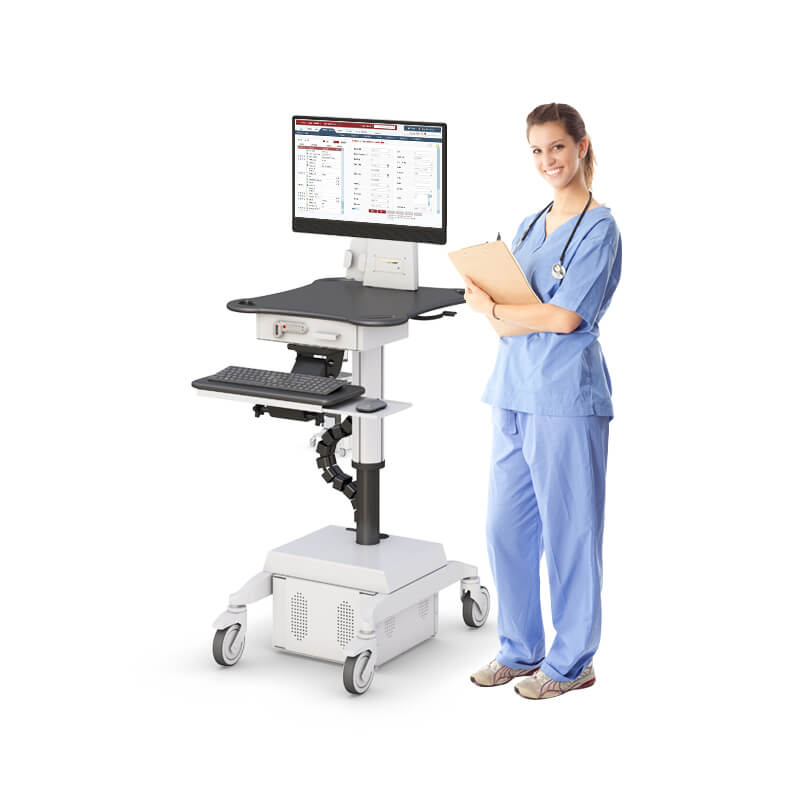
Point-of-care (POC) carts exist to eliminate that gap. They bring the clinical tools — the EHR terminal, the barcode scanner, the documentation platform, the medication storage — to where care is being delivered. The workflow change sounds straightforward. Its effects on documentation accuracy, medication safety, and patient communication are documented and measurable.
This article covers how POC carts change clinical workflow in specific and practical terms, what the research shows about their impact on patient safety, and how to select the right cart for a specific clinical environment. The audience is nursing directors, clinical IT managers, facilities managers, and hospital administrators making equipment decisions for ward, ICU, ED, pharmacy, and community nursing environments.
| Quick Answer — Featured Snippet and AI Citation Optimized
Medical point-of-care carts improve clinical workflows by enabling real-time documentation, medication verification, and patient data access at the bedside rather than at remote workstations. Research published in the Journal of the American Medical Informatics Association (JAMIA) found that bedside POC documentation reduced medication error rates and improved handover accuracy compared to delayed central-station documentation. The Agency for Healthcare Research and Quality (AHRQ) identifies closed-loop medication verification at the point of administration — enabled by barcode scanning on a mobile cart — as one of the highest-impact interventions for reducing adverse drug events. Selecting the right medical point-of-care cart requires matching the cart specification to the specific department’s workflow, disinfection protocol, and patient environment. |
How Do Point-of-Care Carts Change Clinical Workflow?
The workflow change a POC cart introduces is not primarily about efficiency, though efficiency improves. It is primarily about closing the loop between patient contact and clinical documentation at the moment care is delivered. That closure is what produces the safety outcomes the research documents.
Consider medication administration without a POC cart. A nurse prepares medications at a central dispensing area, carries them to the patient’s room, administers them, returns to the central station to scan the barcode or enter the administration into the EHR. In the time between administration and documentation, the nurse may have administered to other patients, responded to a call, or had their attention redirected. The documentation that happens at the central station is a reconstruction from memory, not a contemporaneous record. Research consistently shows that the time gap between action and documentation is a predictor of documentation error rate.
With a POC cart at the bedside, the sequence changes. The medication is scanned and verified against the patient’s EHR record before administration — a closed-loop check that catches discrepancies before they become events. Administration is documented in real time, not reconstructed. Vital signs are entered as they are taken. The patient’s current record is visible during the clinical interaction, not recalled from a corridor review ten minutes earlier.
For physicians, the change is equally significant. A ward round conducted with bedside EHR access allows clinical decisions to be made with current data visible — the latest lab results, the nursing notes from overnight, the medication record. A round conducted from memory or corridor notes is a degraded version of the same process. The POC cart is the infrastructure that makes current-data clinical decision-making possible at the bedside rather than only at a fixed workstation.
The knock-on effects of real-time bedside documentation extend beyond individual patient interactions. Handover quality improves because the record the incoming team receives is complete and contemporaneous rather than partially reconstructed. Communication failures — which the Joint Commission consistently identifies as a leading cause of sentinel events — are reduced when the documentation reflects what actually happened at the time it happened.
What Does the Research Evidence Show About POC Carts and Patient Safety?
The evidence base for POC cart interventions and patient safety outcomes is well-established across several research streams.
The most directly relevant body of research concerns medication safety. The Agency for Healthcare Research and Quality identifies barcode-assisted medication administration (BCMA) — which requires a mobile workstation with a barcode scanner at the point of administration — as one of the highest-impact interventions for reducing adverse drug events. A systematic review of BCMA implementation studies found reductions in medication administration errors of 50–85% in facilities that implemented BCMA with full closed-loop verification. The mobile cart is the enabling infrastructure for this intervention; without bedside scanning capability, closed-loop verification either does not happen or requires workarounds that reduce its effectiveness.
On documentation accuracy, research published in JAMIA found that real-time bedside documentation using POC systems produced fewer discrepancies between administered medications and documented medications compared to retrospective central-station documentation. The effect was strongest for nurses managing high patient loads — exactly the population where documentation gaps are most likely without a POC system.
The Joint Commission’s Sentinel Event data consistently identifies communication failures in care transitions — handovers, shift changes, patient transfers — as a primary causal factor in serious adverse events. POC carts contribute to handover quality by ensuring the incoming team receives a contemporaneous, complete record rather than one reconstructed from memory or informal notes. This indirect effect on communication failure rates is harder to quantify but clinically significant.
For the specific technical specification considerations that affect how POC carts perform in different clinical environments — surface material compatibility with hospital disinfectants, battery sizing for specific workflows, height adjustment for multi-user departments — see the AFC Industries medical cart specification guides and the broader standing desk and workstation range for departments exploring height-adjustable clinical workstations.
What Makes a Medical POC Cart Right for a Specific Clinical Environment?
A POC cart that performs excellently on a general ward may be entirely wrong for an emergency department, a community nursing service, or a telehealth room. Cart selection must be driven by department-specific workflow requirements, disinfection protocols, patient environment constraints, and equipment integration needs — not by a single universal specification.
The table below maps six clinical environments to their primary workflow requirements, key specification needs, and the specification details most commonly missed in each. It is intended as a starting framework for clinical buyers matching cart specification to department context.
| Department | Primary Workflow | Key Specification Needs | What Gets Missed |
| General ward / nursing | Bedside documentation, medication verification, vital sign recording | Height adjustability for multi-user; antimicrobial surface; UPS battery for room-to-room mobility; locking drug storage if medication workflow included | Fixed-height carts fail in multi-user ward environments; battery sizing must cover a full medication round, not just one room |
| Emergency department | High-acuity fast-moving workflow; frequent disinfection; unpredictable patient volume | Impact-resistant surface; hands-free or foot-brake; easy-clean construction with no particle traps; lightweight frame for rapid repositioning | ED carts take more physical damage than any other department; surface durability and brake mechanism are the priority specifications |
| ICU / critical care | Long-session bedside documentation; complex device integrations; proximity to sensitive monitoring equipment | Heavy-duty frame for extended bedside stationing; cable management for multiple device connections; verified MRI-compatibility if applicable; quiet brake mechanism | ICU documentation sessions are longer than ward rounds; the cart must be stable for extended stationing, not just transit |
| Pharmacy / medication management | Medication dispensing, barcode scanning, EHR integration at the point of dispensing | Lockable medication storage; barcode scanner mount; EHR terminal integration; height adjustability for pharmacist height range | The medication safety case rests on closed-loop verification at point of dispensing; a cart without integrated barcode scanning support undermines the workflow it is meant to protect |
| Community / outpatient nursing | Home visits, outpatient clinics, community health; varied environments; vehicle transport | Lightweight frame; compact footprint; robust enough for repeated loading/unloading from vehicle; battery for environments without wall power | Weight is the primary specification for community nursing; a cart that is too heavy to manage solo undermines the safety and usability of the whole workflow |
| Telehealth / virtual care | Video consultation from clinic room or bedside; camera and audio integration; EHR access during call | Stable platform for camera; height adjustment for standing or seated consultation; integrated cable management for AV peripherals; adequate UPS for full session | Telehealth cart stability affects consultation quality directly; an unstable camera produces a low-quality patient experience regardless of connection speed |
What Questions Should Clinical Buyers Answer Before Specifying a POC Cart?
A structured set of pre-specification questions produces a more accurate cart specification than starting from a product catalogue. The questions below surface the department-specific constraints that most commonly determine whether a POC cart delivers its intended workflow benefit.
| Pre-Specification Checklist: 6 Questions Before Choosing a POC Cart
1. What is the disinfection protocol and what cleaning agents are used? This is the most frequently underspecified question in healthcare cart procurement. If the department uses quaternary ammonium compounds, chlorine-based disinfectants, or sporicidal agents, the cart surface must be verified compatible with those specific agents. Incompatible surfaces degrade within months under the cleaning protocol, creating contamination risk from surface degradation and voiding the product warranty. 2. How many users operate the cart per shift and across what height range? A cart used by a team of nurses ranging from 5’2” to 6’0” needs a height adjustment range that covers both extremes. Without height adjustability, the cart is configured for one user’s height and wrong for everyone else. Multi-user carts need memory presets or quick-release adjustment mechanisms to make reconfiguration practical rather than theoretical. 3. What is the battery requirement for the intended workflow? Map the full workflow circuit: how many patient rooms per round, how long at each room, what devices are running. Calculate the total session length and the device wattage draw. The battery must cover the full session with margin. A battery sized to three rooms when the ward round covers twelve is not a minor specification error — it is a workflow failure that happens every day. 4. Does the workflow require medication storage, and if so, what level of security? Controlled drug storage on a mobile cart requires locking mechanisms that meet the department’s regulatory requirements. Verify the cart’s locking specification against the controlled drug storage standards applicable in your jurisdiction before purchase. A cart specified for medication management without compliant secure storage is not compliant regardless of its other qualities. 5. What device integration does the workflow require? Barcode scanners, biometric login systems, signature pads, printer mounts, and peripheral device trays all need to be planned as part of the cart specification. Devices added after delivery as afterthoughts typically require cable management workarounds, ad-hoc mounting solutions, and surface modifications that reduce the cart’s cleanability and durability. 6. What are the environment-specific constraints? Community nursing carts must be light enough to be managed solo and compact enough to fit in a vehicle. ED carts must survive physical contact in fast-moving environments. ICU carts must be stable enough for extended bedside stationing. Telehealth carts need stable camera platforms and adequate AV integration. A cart that doesn’t account for its operating environment fails in practice regardless of its bench specifications. |
AFC Industries’ medical point-of-care carts are available across clinical configurations for general ward, ICU, ED, pharmacy, community, and telehealth environments. Contact the AFC Industries team with your department type, patient census, disinfection protocol, and device integration requirements to discuss the specification that fits your specific workflow.
The Investment Case in Plain Terms
A medical point-of-care cart is not a mobile workstation that happens to be in the clinical environment. It is the infrastructure that makes a specific, evidence-backed set of workflow improvements possible: real-time documentation, closed-loop medication verification, bedside clinical decision-making with current data, and complete contemporaneous records that support high-quality handovers.
Each of those workflow improvements has a documented patient safety benefit. None of them is achievable at the level of reliability and consistency that the safety case requires when the clinical tools are back at a central workstation and the nurse is at the bedside.
The specification work required to match a cart to a department is not onerous — it is the six questions above, answered specifically for the environment. Getting that work right at the procurement stage avoids the far more expensive alternative: discovering in deployment that the cart doesn’t fit the workflow, can’t survive the cleaning protocol, or runs out of battery before the round is complete.