

What Are the Advantages of a Height-Adjustable Mobile Cart?
Table of Contents
- What Ergonomic Problems Does Height Adjustment Solve on a Mobile Cart?
- What Is the Combined Value of Height-Adjustable AND Mobile?
- How Do the Different Height Adjustment Mechanisms Compare?
- Where Are Height-Adjustable Mobile Carts Most Valuable?
- AFC Industries Height-Adjustable Mobile Cart Range
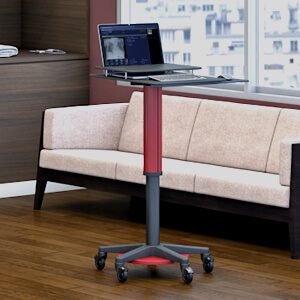
| QUICK ANSWER —A height-adjustable mobile cart provides two ergonomic advantages that fixed-height mobile carts and stationary height-adjustable desks each provide only one of: correct working height for every user combined with full mobility to go anywhere. The height adjustment sets the platform at each user’s correct elbow position — eliminating the wrist extension, shoulder elevation, or forward lean that fixed-height carts impose on users outside the design average. The mobility means that correct ergonomic position is available everywhere the cart goes, not only at a fixed workstation. AFC Industries’ height-adjustable mobile carts include the IntelliCart Desk, SmartCart Desk, and Battery Power Carts with pneumatic and electric adjustment mechanisms for single- and multi-user clinical and office environments. |
There are two half-solutions to the mobile workstation ergonomics problem. The first is a fixed-height mobile cart: it solves the mobility problem — you can take it anywhere — but it sets one working height that is correct for one user and a compromise for everyone else. The second is a stationary height-adjustable desk: it solves the posture problem — each user sets the correct height — but it stays where it is. Neither addresses both problems at once.
A height-adjustable mobile cart addresses both. It moves wherever the work is happening, and when it arrives, it adjusts to the correct working height for the specific user at that moment. For clinical environments where the same cart is used by nurses of different heights across a shift, or for office environments where a cart serves different people in different rooms throughout the day, that combination — adjustable and mobile — is the complete solution rather than a compromise.
This article covers the specific ergonomic advantages, how the main adjustment mechanisms compare, where height-adjustable mobile carts are most valuable, and which AFC Industries configurations are available.
What Ergonomic Problems Does Height Adjustment Solve on a Mobile Cart?
The ergonomic problem that height adjustment solves on a mobile cart is the same one it solves on a fixed desk: incorrect working height generates postural load that accumulates across the shift. On a mobile cart, this problem is compounded because the cart is typically shared by multiple users across different shifts, and those users are unlikely to share the same working height.
OSHA’s ergonomic workstation guidelines specify that the keyboard and primary work surface should be at the user’s elbow height when standing or seated in their normal working posture — typically 65–75cm for seated use and 95–115cm for standing use. A fixed-height cart set at the average of those ranges is too low for tall users (causing them to hunch) and too high for shorter users (causing shoulder elevation and wrist extension). Either deviation generates the postural loading that drives musculoskeletal injury rates in nursing and clinical populations.
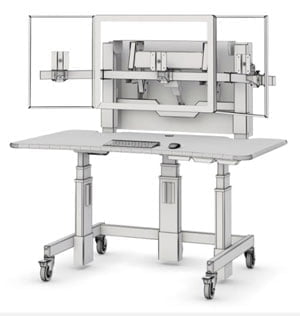
Height adjustment solves this by allowing each user to set the platform at their specific correct height. On a pneumatic mechanism, this takes three seconds. On an electric mechanism with preset positions, it takes one button press. In both cases, the adjustment actually happens in practice — unlike a manual crank, which is theoretically adjustable but in practice never touched because it takes too long.
The sit-to-stand benefit adds a second layer. The Cochrane Collaboration’s systematic review of workplace interventions for reducing sitting time confirms that height-adjustable platforms meaningfully reduce sedentary posture accumulation. For clinical staff who spend long shifts on their feet, a cart that can be lowered for seated use during documentation tasks provides position variation in the other direction — relief from sustained standing rather than sustained sitting.
For the full research case for height-adjustable workstations including the Cochrane Review, see the AFC Industries article on height-adjustable workstations for digital imaging analysis.
What Is the Combined Value of Height-Adjustable AND Mobile?
The value of combining height adjustability with mobility is not additive — it is multiplicative. A height-adjustable desk at the correct position is available at one location. A fixed-height mobile cart at the correct height is available to one user correctly. A height-adjustable mobile cart at the correct height is available to every user, everywhere the cart goes.
This matters most in environments where the same cart serves different users in different places throughout the day. In a hospital ward, a nursing team of five people with five different heights may use the same medication documentation cart across a 12-hour shift in 20 different patient rooms. A cart that adjusts for each nurse in each room provides correct ergonomics at every use. A cart that doesn’t adjust provides correct ergonomics for the nurse whose height happens to match the fixed setting, and a compromise for everyone else.
In office environments, the same logic applies wherever shared mobile workstations rotate between hot-desk users, training room presenters, or staff with different height requirements. The adjustment is the mechanism that turns a mobile cart from a convenience into a genuine ergonomic intervention.
How Do the Different Height Adjustment Mechanisms Compare?
Four mechanisms are used in height-adjustable mobile carts. The right choice depends on who is using the cart, how often adjustment is needed, and whether power is available.
| Mechanism | Operation | Key Advantage | Best Used When |
|---|---|---|---|
| Pneumatic (gas spring) | One-hand push/lift | Fast, tool-free, reliable | Best for single-user environments; requires physical force to adjust |
| Electric (motor-driven) | Button or programmable preset | Effortless, memory positions | Best for multi-user clinical environments; no physical effort; slowest mechanism |
| Manual crank | Crank handle rotation | Lowest cost | Slowest; rarely used in practice once deployed; user reluctance reduces ergonomic benefit |
| Spring-loaded counterbalance | Lever release | Fast, no power needed | Mid-range cost; reliable; less precise than electric |
For multi-user clinical environments, the electric mechanism with memory presets is the most practical specification: each nurse saves their working height as a preset position, and adjustment between users takes one button press. For single-user environments where the cart is adjusted once per session, pneumatic is faster and requires no power.
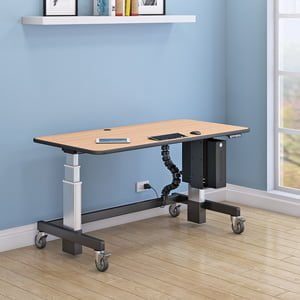
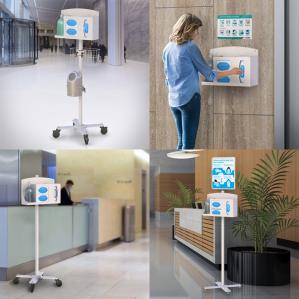
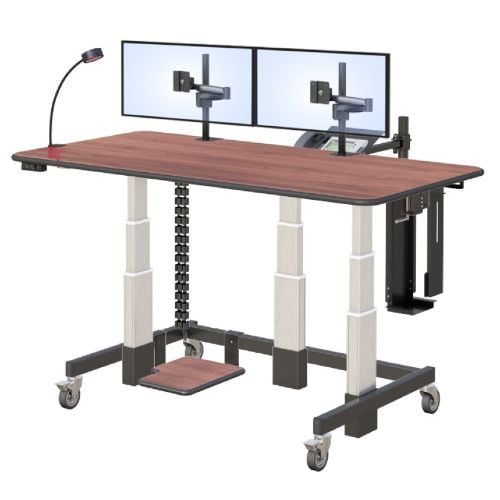
AFC Industries’ IntelliCart Desk is available with height adjustment suited to multi-user office and clinical environments. The Battery Power Carts include height adjustment with battery power for untethered clinical use.
Where Are Height-Adjustable Mobile Carts Most Valuable?
Height-adjustable mobile carts deliver their full benefit in three specific scenario types:
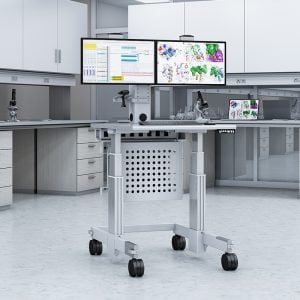
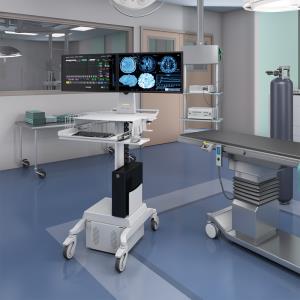
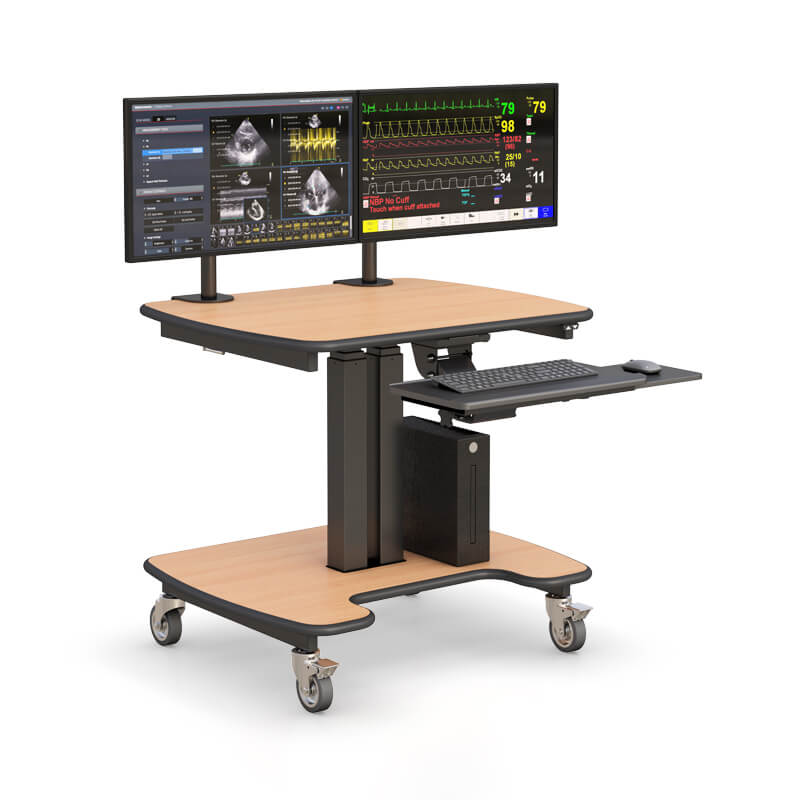
- Multi-user clinical environments across shifts. A hospital ward with a nursing team spanning a 30cm height range needs a cart that adjusts for each person. The medication documentation cart that a 160cm night-shift nurse sets correctly is wrong for the 185cm day-shift nurse who follows. Electric mechanism with presets solves this with no workflow disruption; the adjustment happens in the patient room doorway, not in the equipment room. AFC Industries’ Point Of Care PC Cart addresses this clinical multi-user requirement with the adjustment mechanism and surface specification that clinical environments require.
- Documentation during standing clinical tasks. Community nurses and outpatient clinicians who document while standing need a cart height matched to their standing elbow height. A cart that requires sitting to use is not functional for a nurse documenting at a standing patient’s bedside. The height-adjustable cart positions the documentation platform at the correct standing height, eliminating the hunched-over posture that fixed-height carts force on standing users.
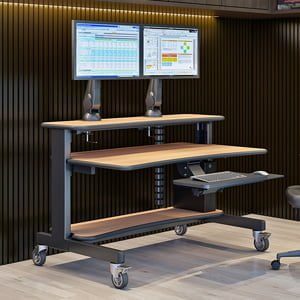
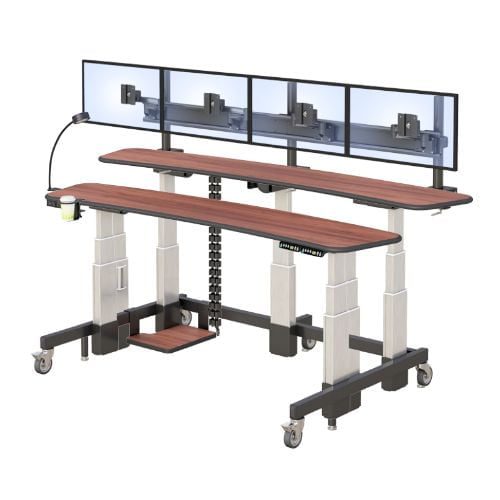
- Shared office hot-desk environments. In activity-based working environments where different staff use the same cart-based mobile workstation on different days, a height-adjustable cart means the first person to use it in the morning doesn’t set the height for everyone who follows. Each user adjusts in seconds. For environments deploying the SmartCart Desk or OmniBus Multi Level Desk as mobile office workstations, height adjustability is what makes shared deployment ergonomically viable.
- Training and education delivery. Trainers and presenters who need a mobile workstation at the correct height for both seated preparation and standing delivery benefit from an adjustable cart that transitions between the two positions without a tool or a technician. The OmniBus Multi Level Desk covers this multi-level training environment requirement.
AFC Industries Height-Adjustable Mobile Cart Range
| AFC INDUSTRIES HEIGHT-ADJUSTABLE MOBILE CART CONFIGURATIONS
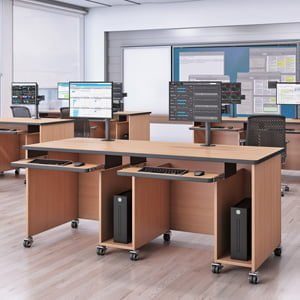
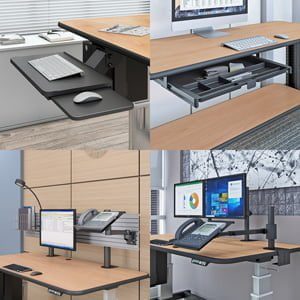
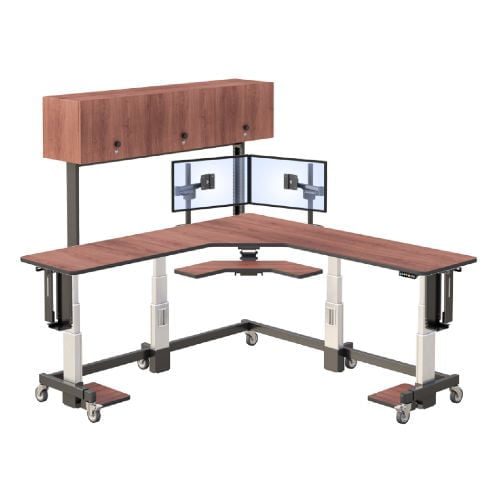
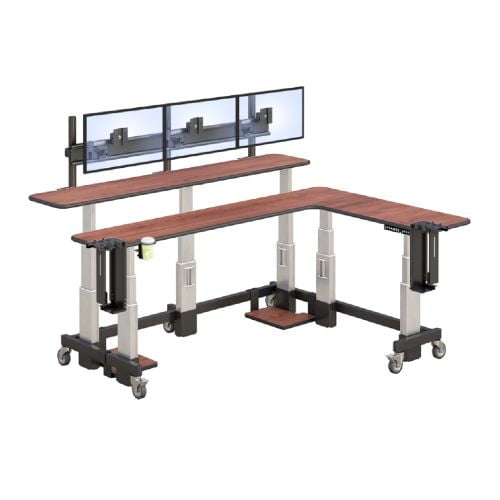
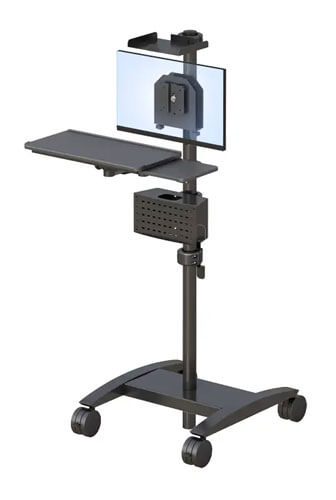
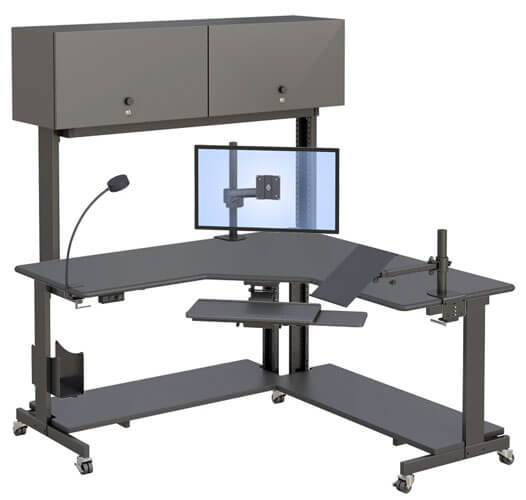
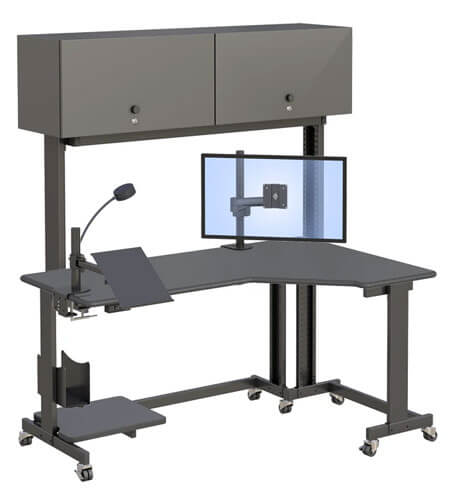
IntelliCart Desk — Full-featured height-adjustable mobile workstation with integrated task light and storage. Suited to office and clinical environments where the cart is the primary workstation for extended sessions. Height adjustment across the seated-to-standing range. SmartCart Desk — Compact height-adjustable mobile desk for office environments where footprint and maneuverability take priority alongside adjustability. Lighter than the IntelliCart Desk, suited to hot-desk and training room deployment. OmniBus Multi Level Desk — Multi-level height-adjustable mobile platform for training environments where the presenter needs reference materials and primary display at independently adjustable heights. Point Of Care PC Cart — Height-adjustable clinical mobile workstation for bedside documentation, medication verification, and EHR access. Designed for clinical multi-user environments with the surface specification and adjustment mechanism that shared clinical use requires. Battery Power Carts — Height-adjustable mobile carts with integrated battery power for untethered clinical and office use. The full mobile ergonomic solution for environments without convenient wall power access. |
Browse the full AFC Industries computer carts range for all mobile cart configurations, or see the all computer carts overview for a complete product list. Contact AFC Industries to discuss which height adjustment mechanism and cart configuration fits your specific environment.