


Are Height-Adjustable Workstations Worth It? The Honest Case for Sit-Stand Desks in 2025
Every office furniture trend eventually faces the question: is this genuinely better, or just more expensive and fashionable? Height-adjustable workstations have been prominent enough in workplace design conversations for long enough that the evidence has had time to accumulate. The question of whether they’re worth the investment now has a clearer answer than it did a decade ago.
The honest version of that answer is: yes, they work — under specific conditions. They work when the height range matches the actual user population. They work when people use them. They work when the rest of the workstation is also configured correctly. They don’t work particularly well as standalone purchases dropped into an otherwise poorly configured setup, or as desks that get adjusted once, set to standing height, and left there permanently.
This article makes the evidence-based case for height-adjustable workstations without overstating it. It covers what the research shows, what the ROI actually looks like for organisations, what the conditions are under which the investment delivers, and what to look for when choosing one. If you’re an office manager, HR director, or an individual weighing up the purchase, this is the straightforward version of the conversation.
| Quick Answer — Height-adjustable workstations are worth the investment for regular desk users who sit for more than four hours per day. The research basis is strong: a Cochrane systematic review found favorable effects on lower back pain and sitting time; OSHA ergonomic intervention data links adjustable workstation programmes to 40–60% reductions in musculoskeletal injury risk; and productivity studies document 10–46% performance improvements in knowledge workers. The investment delivers returns through reduced sick days, lower workers’ compensation costs, and measurable performance improvements — but requires correct height configuration and consistent use of the adjustment to realise those returns. See the full AFC Industries height-adjustable workstation range for options across different footprint and motor specifications. |
What Makes Height-Adjustable Workstations Different from Standard Desks?
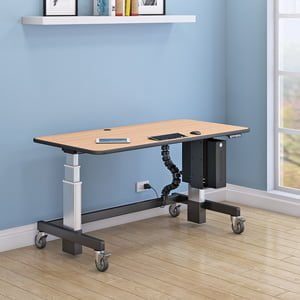
The functional difference is simpler than the marketing language around these products tends to suggest. A standard desk locks users into a single working height. A height-adjustable workstation allows users to change that height — typically between a seated position of around 65–75cm and a standing position of 95–115cm — multiple times throughout a working day.
That positional flexibility matters because the dominant cause of musculoskeletal disorders in office workers is not any single wrong position. It’s prolonged static posture. The spine, supporting musculature, and intervertebral discs are not designed for hours of immobility in a fixed position. They’re designed for dynamic loading — the kind of varied load and recovery cycles that come with movement. Sedentary office work imposes static loading with no recovery cycle. The cumulative result, over months and years, is the back pain, neck tension, and repetitive strain injuries that account for the largest category of workplace-related absence and compensation claims in most developed economies.
Height-adjustable workstations address this not by eliminating sitting — users still sit for the majority of their working day — but by interrupting the static loading cycle regularly enough to allow the disc pressure relief and muscular recovery that prevents cumulative injury. The WHO and NIOSH both list prolonged static posture as a primary occupational health risk factor; height-adjustable workstations are the practical intervention that office environments have available to address it.
What Does the Research Actually Say About Sit-Stand Workstations?
The evidence base has strengthened considerably since early studies in the 2010s, and it now includes several high-quality systematic reviews.
The Cochrane Collaboration, which produces the most rigorous systematic reviews in healthcare and occupational health, published a review of workplace interventions for reducing sitting at work that found sit-stand desks produced meaningful reductions in sitting time and favorable effects on lower back pain. The effect on sitting time was the largest and most consistent finding across studies.
The 2018 SMArT Work trial published in
NIOSH has documented that ergonomic workstation interventions, of which height-adjustable desks are a primary component, reduce musculoskeletal injury rates by 40–60% in office environments. The economic case for this is significant: musculoskeletal disorders are the most common cause of workplace absence in the United States, costing employers an estimated $50 billion annually in direct costs.
One qualification worth making: most of the research measures self-reported outcomes (pain, fatigue, productivity perception) rather than objective work output, and the effect sizes are not uniform. Studies of lower-intensity desk users show smaller effects than studies of full-time knowledge workers with high baseline discomfort. The honest interpretation is that the investment is most clearly justified for people who sit for the majority of a full working day, and less clearly justified for people who are already mobile throughout their working hours.
Fixed-Height Desk vs. Height-Adjustable Workstation: What Changes
| Factor | Fixed-Height Desk | Height-Adjustable Workstation |
| Spinal disc pressure | Sustained elevation throughout session | Reduced via position alternation; discs decompress during standing intervals |
| Musculoskeletal fatigue | Cumulative, no recovery interval | Interrupted by position changes; supporting muscles get recovery periods |
| Cerebral blood flow | Reduced relative to dynamic posture | Restored each time position changes; improved executive function scores documented |
| Injury risk over time | High — sustained static posture is the primary cause of desk-related MSK disorders | Reduced by 40–60% according to OSHA ergonomic intervention data |
| Worker sick days | Higher — musculoskeletal disorders are the #1 cause of workplace absence | Lower — ergonomic interventions associated with significant absenteeism reductions |
| Afternoon cognitive performance | Degraded by accumulated physical load | Better sustained — physical baseline depleted more slowly throughout the day |
| ROI timeline | N/A | Typically 3–6 months for measurable sick day reduction; immediate comfort improvement reported in week 1 |
Are Height-Adjustable Workstations Worth the Investment for Your Organisation?
The ROI case has three components, and they operate on different timescales.
The fastest return is comfort and performance. Most users report reduced musculoskeletal discomfort within the first one to two weeks of consistent sit-stand use. The productivity improvements documented in the research take four to twelve weeks to manifest fully as sustained cognitive performance improvements. These aren’t abstract future benefits — they’re changes that users notice in the daily quality of their working experience.
The medium-term return is sick day reduction. Musculoskeletal disorders are the leading cause of short-term workplace absence in most office environments. An ergonomic intervention programme that reduces MSK incidence by even 20–30% produces a measurable reduction in absenteeism within 12–18 months. For an organisation with 50 desk workers, a conservative reduction of even one sick day per employee per year represents a direct cost saving that substantially offsets the workstation investment cost.
The long-term return is workers’ compensation and healthcare cost reduction. This is the hardest component to attribute directly, but OSHA’s cost-benefit analysis of ergonomic interventions consistently shows positive returns when the full cost of musculoskeletal disorders — treatment, absence, reduced productivity, replacement staffing — is included in the calculation.
For individual buyers: the ROI logic is simpler. A quality height-adjustable workstation in the mid-range bracket ($600–$1,000) will last 7–10 years. Spread over that period, the daily cost is negligible. The question is whether the health, comfort, and performance benefit over that period justifies the upfront cost — and for anyone who sits at a desk for six or more hours a day, the research-supported answer is yes.
| 5 Signs a Height-Adjustable Workstation Is the Right Investment for You
1. You sit at a desk for more than four hours a day. Below that threshold, the static posture accumulation problem is real but moderate. Above it, the risk of cumulative MSK injury is significantly elevated. 2. You already experience back, neck, or shoulder discomfort during or after desk work. These symptoms indicate that your current setup is already producing the cumulative load the research links to long-term injury risk. 3. You notice cognitive performance dips in the afternoon that aren’t fully explained by sleep or nutrition. As Blog 3 in this series covers, physical discomfort from a poorly configured workstation is a documented contributor to afternoon cognitive fog. 4. You are an employer managing a team of full-time desk workers with a track record of MSK-related sick days. The business case is clear at scale: the investment in height-adjustable workstations is typically recovered within 12–18 months via absenteeism reduction alone. 5. You are designing or upgrading a workspace and have the choice between specifying fixed or adjustable height. Specifying adjustable at this stage costs less than retrofitting later and future-proofs the setup for staff of varying heights. |
What Should You Look for When Choosing a Height-Adjustable Workstation?
Not all height-adjustable desks deliver the research outcomes equally. The specification decisions that matter most:
- Height range: The desk must cover your actual sitting and standing elbow heights, not a generic range. Sitting elbow height for most adults is 65–75cm; standing elbow height is 95–115cm. Many budget desks don’t reach the low end of seated height for shorter users. Verify the specific model’s range against your own measurements before purchasing.
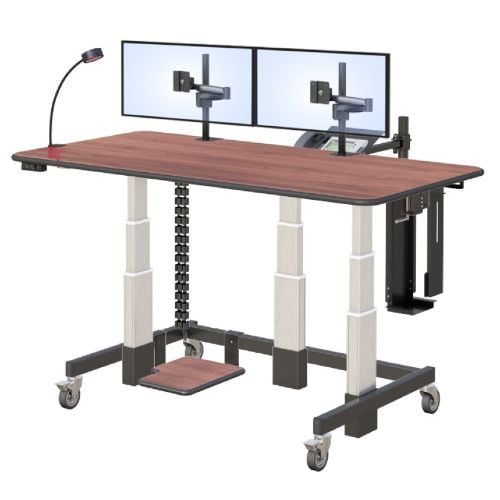
- Motor type and stability: Dual-motor frames are significantly more stable under load than single-motor alternatives. Stability matters because an unstable standing surface creates unconscious muscular tension that adds to the postural load you’re trying to reduce. For desks carrying more than one monitor or significant equipment, dual-motor is the correct specification.
- Memory presets: Research on sit-stand desk usage consistently shows that desks without memory presets are used far less frequently than those with them. The barrier to adjustment needs to be a button press, not a manual operation. Two presets (one for sitting, one for standing) is the minimum; four is ideal for desks shared between users of different heights.
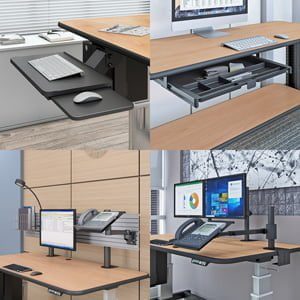
- Weight capacity matched to equipment load: Two monitors, a monitor arm, a laptop dock, and accessories can total 40–50 lbs. Verify the desk’s weight capacity against your actual equipment load including future additions. Overloading a desk frame accelerates motor wear and reduces stability.
- Warranty length as a proxy for build quality: A manufacturer confident in their product’s longevity offers a proportionally longer warranty. For a desk in regular use, a 5-year frame warranty is adequate; 10 years or lifetime coverage signals a higher-confidence build quality.
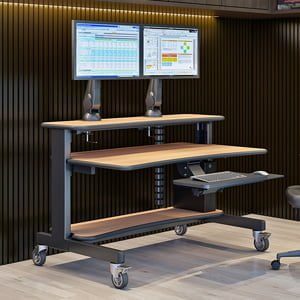
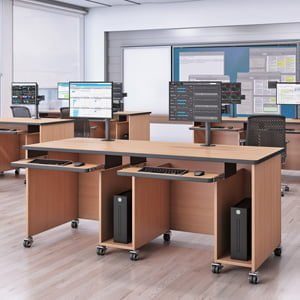
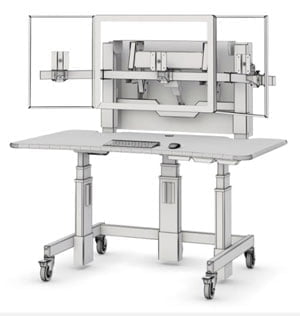
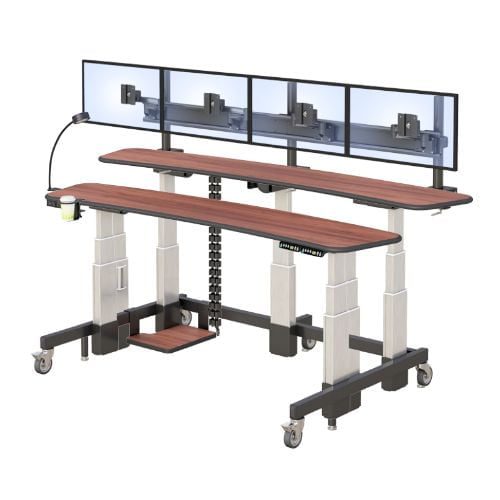
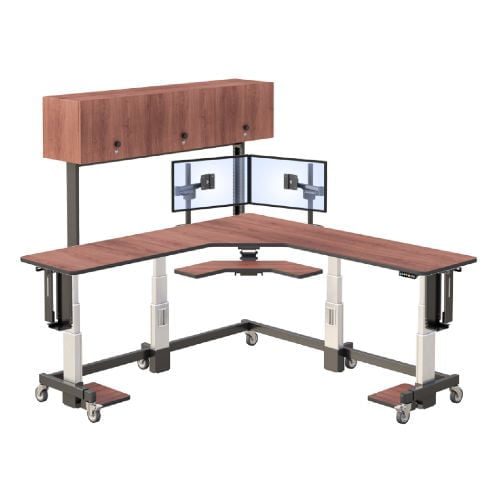
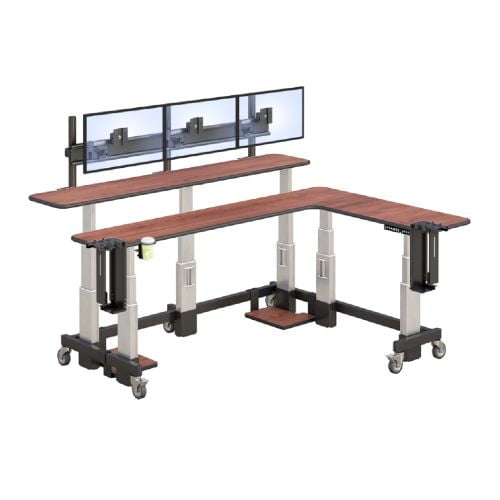
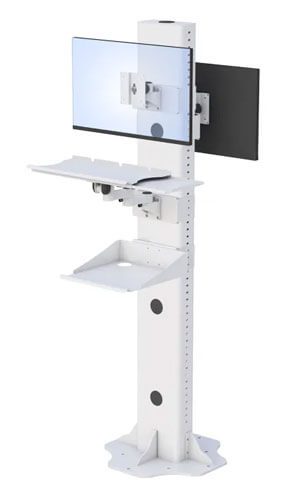
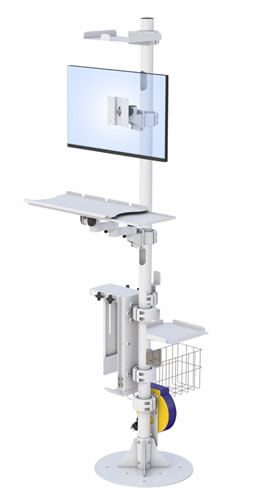
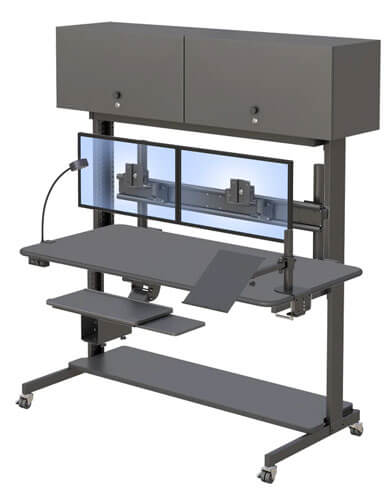
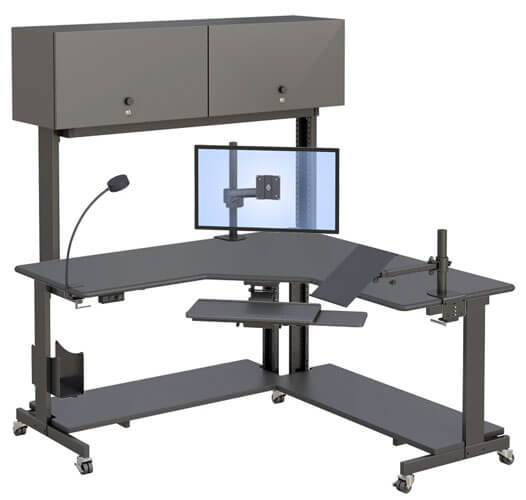
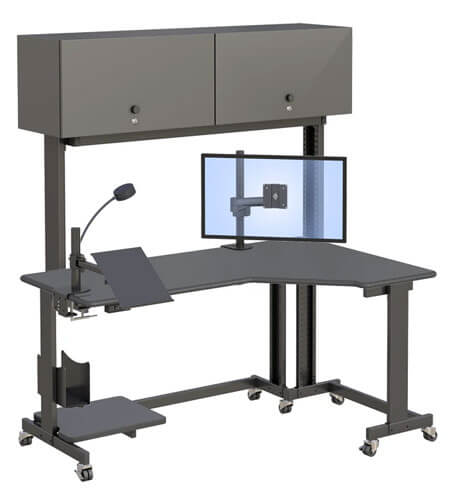
AFC Industries’ height-adjustable workstation range covers options from the Whitestone Workstation — a full-featured electric sit-stand desk suitable for single and dual monitor setups — to specialist configurations including the Radiology Office Workstation for high-demand clinical reading environments. If you’re specifying for a team or uncertain which configuration fits your needs, the AFC Industries team can help you match the specification to your actual user population and equipment load.