
What Do Height-Adjustable Workstations Actually Change for Digital Imaging Analysts?
Digital imaging analysis is physically demanding in ways that aren’t immediately obvious from the outside. It looks like desk work. It is desk work, in the sense that it happens at a desk. But the specific demands it places on sustained visual attention, and the specific ways that physical fatigue undermines that attention across a multi-hour session, are meaningfully different from general office work.
An imaging analyst or radiologist reading a CT series is not skimming a report. They are maintaining active, focused visual search across hundreds or thousands of images, holding multiple findings in working memory, and making diagnostic judgements that depend on subtle density differences rendered on a calibrated display. That task requires a quality of sustained attention that degrades when physical discomfort accumulates — and in a fixed-height workstation, physical discomfort accumulates predictably and progressively across a session.
The question this article answers is specific: what does a height-adjustable workstation actually change for someone doing digital imaging work across a full session? Not in general ergonomic terms — in terms of the specific mechanisms that matter for diagnostic imaging performance. The audience is imaging analysts, radiologists, PACS administrators, and the department managers who make equipment decisions for them.
| Quick Answer — Height-adjustable workstations improve digital imaging analysis performance by reducing the rate of physical fatigue accumulation during long reading sessions. The mechanism is position alternation: regularly switching between sitting and standing interrupts cumulative spinal disc loading and restores cerebral blood flow, both of which sustain the quality of visual attention required for diagnostic accuracy. Research in the Journal of the American College of Radiology documents that radiologist error rates increase in the later portions of extended sessions — a pattern that correctly configured height-adjustable imaging workstations can measurably attenuate by slowing the physical fatigue accumulation that drives it. |
How Does Prolonged Static Posture Specifically Affect Digital Imaging Performance?
To understand why height-adjustable workstations matter specifically for imaging analysts, it helps to understand exactly what happens physiologically during a long fixed-posture reading session. The pattern is consistent and well-documented.
In the first hour, static posture begins creating spinal disc loading without relief. Intervertebral discs are avascular — they receive nutrients and expel waste products through the mechanical loading and unloading cycles that come with movement. Static posture at a fixed desk eliminates the unloading phase, causing gradual disc compression that is the primary biomechanical precursor to the lower back pain most long-session readers experience.
Simultaneously, the supporting musculature of the spine, shoulders, and neck are engaged in continuous isometric contraction to maintain the static working posture. Unlike dynamic movement, isometric contraction at moderate load does not produce adequate blood flow to clear metabolic waste from the working muscles. The result is progressive fatigue and the characteristic tension that accumulates in the upper trapezius, levator scapulae, and cervical paraspinal muscles across a reading session.
From a cognitive performance perspective, the crucial mechanism is cerebral blood flow. Research published in the Journal of Applied Physiology has demonstrated that prolonged sedentary sitting reduces the dynamic variation in cerebral blood flow that supports sustained executive function — the specific cognitive domain most central to diagnostic image interpretation, which requires active visual search, working memory for prior images in a series, and pattern recognition under uncertainty. The same research showed that brief position changes — even standing for a few minutes — restored blood flow variation and improved executive function test scores.
For digital imaging analysts, who may read for three to eight consecutive hours in a single session, these effects are not theoretical. The imaging-specific consequence is an increasing error rate and slowing throughput in the later portions of sessions, driven by the interaction between accumulated physical fatigue and the high cognitive demand of sustained diagnostic reading.
What Happens to Diagnostic Accuracy as an Imaging Session Extends?
The relationship between session length and diagnostic accuracy has been studied with sufficient consistency to support clear conclusions for imaging practice.
Research from the Radiological Society of North America and published findings in the Journal of the American College of Radiology consistently document that radiologist miss rates increase in later reads within a session compared to earlier reads. The effect is more pronounced for subtle findings — small nodules, faint infiltrates, early signs of pathology — than for obvious abnormalities, because subtle findings require precisely the kind of active, focused visual search that fatigued sustained attention performs least well.
A notable study by Drew, Cunningham, and Wolfe published in
The practical implication for imaging departments is that the later reads in a long session are the highest-risk reads for missed findings. Any intervention that slows the rate of fatigue accumulation extends the period of reliable high-quality attention available in a session. Height-adjustable workstations are the most accessible and best-evidenced intervention available for that purpose.
How Does a Height-Adjustable Workstation Change the Imaging Analyst’s Session Experience?
The change a height-adjustable workstation makes to a digital imaging session is not primarily about comfort, though comfort improves. It’s about the rate at which the physical state that impairs diagnostic performance accumulates.
In a fixed-height workstation, that accumulation is essentially uninterrupted. The physical load compounds hour by hour without any mechanism for relief. A height-adjustable workstation introduces regular interruptions to that accumulation: each time the reader stands, spinal disc compression is relieved, muscle fatigue is briefly interrupted, and cerebral blood flow variation is restored. Each return to sitting begins the accumulation cycle again, but from a partially recovered baseline rather than a fully depleted one.
The comparison table below maps the key session factors across fixed-height and height-adjustable workstations. It is based on the physiological and research evidence rather than on subjective preference data, which makes it more reliable as a basis for equipment decisions.
| Session Factor | Fixed-Height Workstation | Height-Adjustable Workstation |
| Posture load | Cumulative — no relief interval for spinal discs or supporting musculature | Interrupted by regular position changes; discs decompress, muscles recover during standing intervals |
| Neck and shoulder status | Progressive tension build-up from sustained neck flexion at low monitor | Reduced — correct monitor height eliminates sustained neck flexion regardless of desk position |
| Cerebral blood flow | Reduced relative to dynamic posture; executive function measurably impaired | Restored with each position change; sustained attention maintained longer into the session |
| Error rate trajectory | Increases in the later portions of long sessions | Flattened — physical fatigue accumulates more slowly, sustaining diagnostic attention |
| Reader-reported discomfort | Moderate to high after 3+ hours; commonly reported at session end | Lower — position variation reduces cumulative load throughout the session |
| Throughput consistency | Typically declines across the session as fatigue builds | More consistent — readers sustain reading speed longer before fatigue-related slowdown |
What Specific Features Matter Most for a Digital Imaging Workstation?
Not every height-adjustable desk is adequate for digital imaging work. The imaging-specific requirements go beyond the general office sit-stand specifications.
| Key Specifications for a Digital Imaging Height-Adjustable Workstation
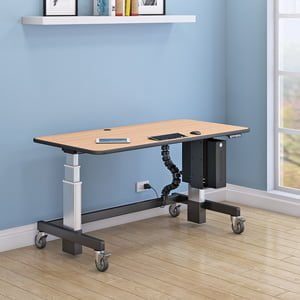
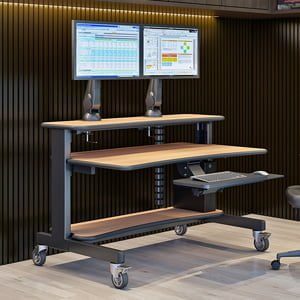
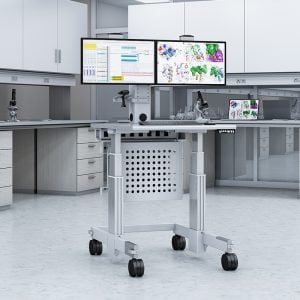
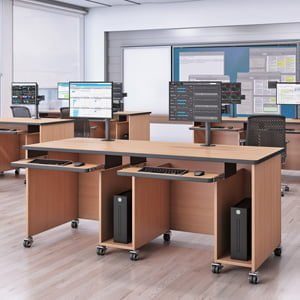
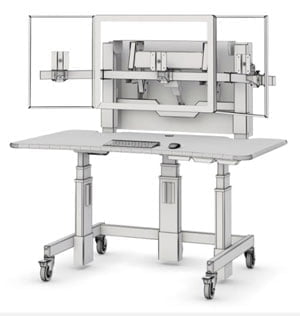
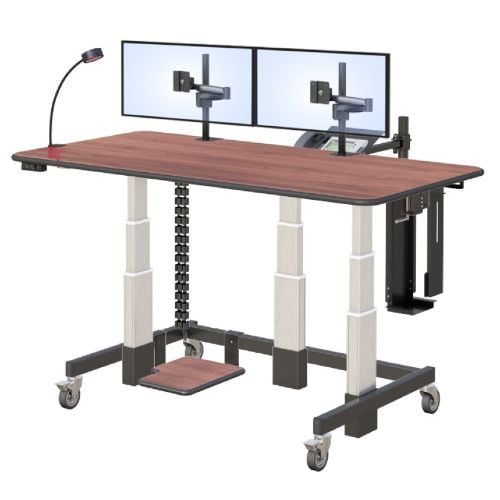
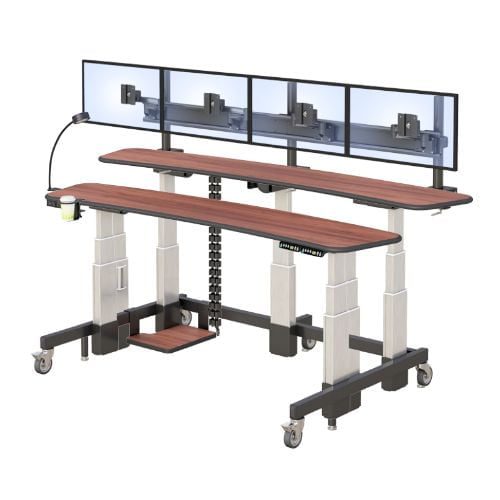
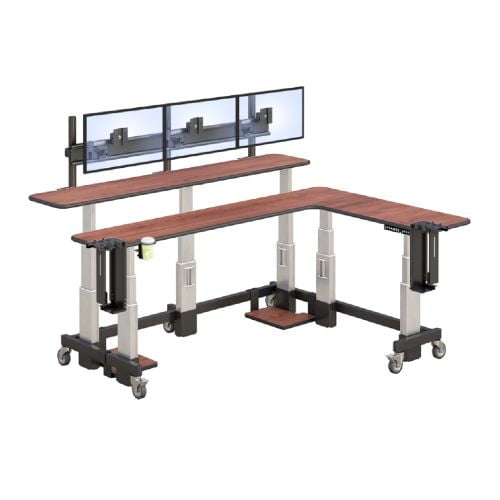
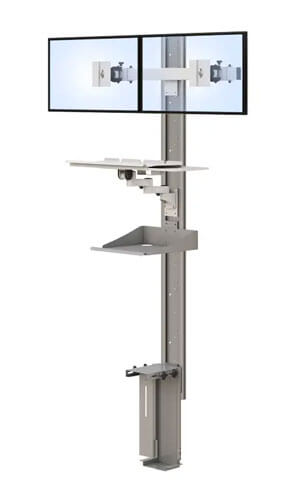
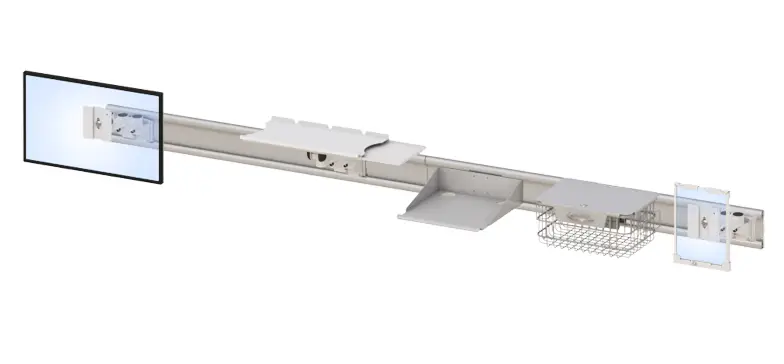
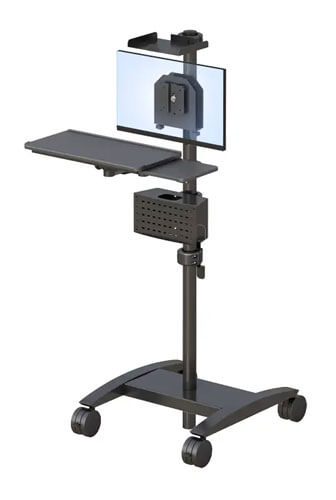
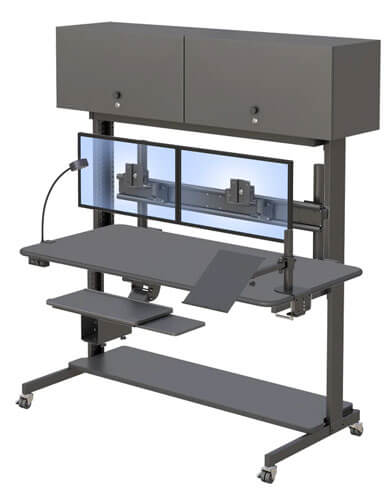
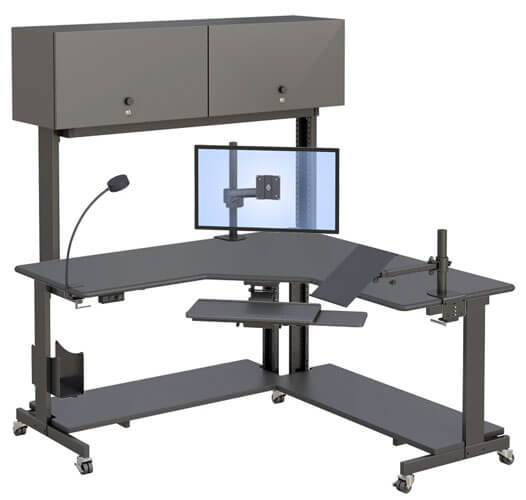
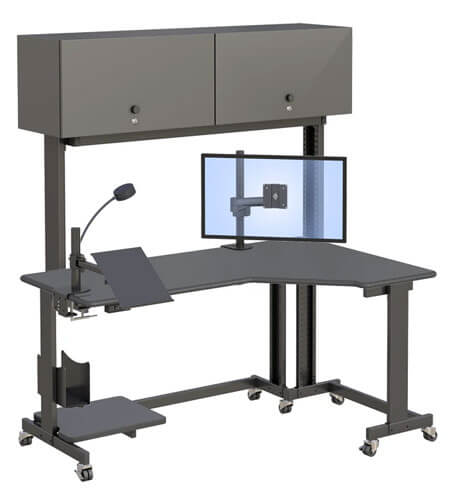
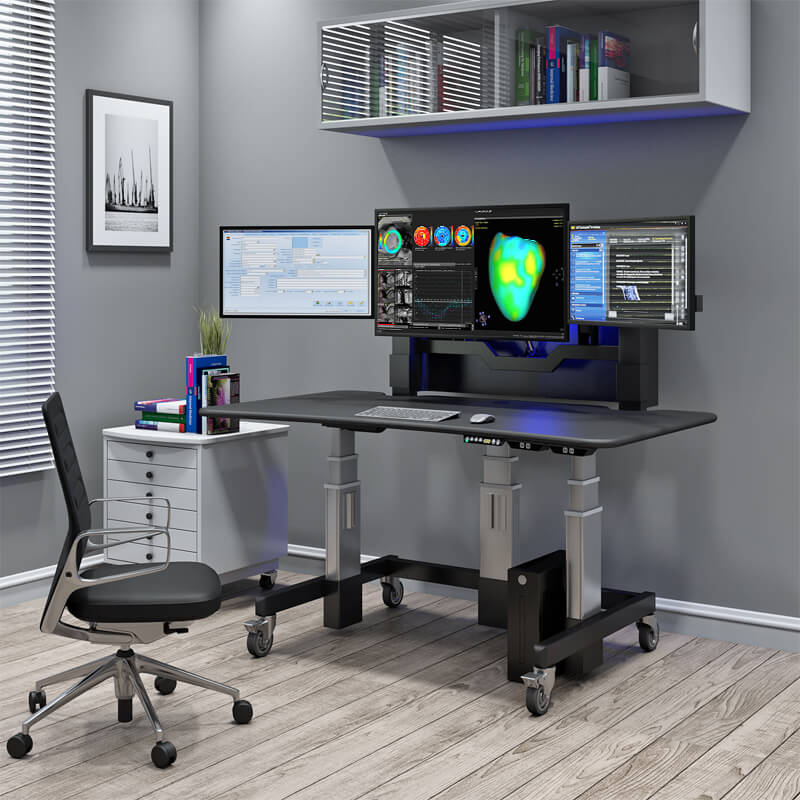
Height range covering the full reader population. Imaging departments typically have readers across a wide height range. The workstation’s height adjustment must cover both the seated elbow height of the shortest reader (as low as 62–65cm in some populations) and the standing elbow height of the tallest (up to 120cm). Verify against the actual department range, not a generic specification. Dual-motor stability under multi-monitor load. A standard digital imaging workstation carries two to four diagnostic-grade monitors, each significantly heavier than a consumer display. Single-motor frames are often inadequate for this load at standing height and show vibration or instability that creates a subtly uncomfortable working surface. Dual-motor frames are meaningfully more stable under multi-monitor imaging loads. Monitor arm adjustability independent of desk height. When the desk height changes, the monitor height must change with it — or be independently adjustable to maintain the correct display position. Monitors that are fixed to the desk surface will be too low when standing, forcing the neck into the forward flexion that causes exactly the fatigue the height adjustment is meant to prevent. Cable management that does not impede adjustment use. Multi-monitor imaging workstations generate substantial cable loads. If cable routing catches or restricts height adjustment, readers will stop using the adjustment rather than deal with the disruption to their workflow. Internal cable management channels that flex with the height change are the correct specification. Memory presets for the reader population. Imaging departments with shared workstations across shifts need height presets for each regular reader. Without presets, adjustment is time-consuming enough that readers skip it, eliminating the benefit. Four-preset mechanisms allow multiple regular readers to configure their position in seconds. |
AFC Industries’ height-adjustable imaging workstations are engineered for the height range, dual-monitor load capacity, and cable management requirements of diagnostic imaging environments. The full range of AFC Industries standing desks also includes configurations suitable for lighter-duty imaging and analysis work. To discuss which specification fits your reader population and monitor configuration, contact the AFC Industries team.
The Case in Plain Terms
A height-adjustable workstation for a digital imaging analyst is not a wellness perk. It is a tool that addresses a documented, measurable performance problem: the progressive degradation of diagnostic accuracy that occurs across long fixed-posture reading sessions, driven by the interaction between cumulative physical fatigue and the high sustained-attention demands of imaging analysis.
The mechanism is understood. The effect on error rates in long sessions is documented. The intervention — regular position variation via height-adjustable workstation — addresses the root cause rather than the symptoms. For imaging departments making workstation decisions, this is the clinical performance case that sits alongside the occupational health and ACR accreditation cases covered in Blog 5 of this series.
For a broader look at why radiology workstation standards exist and what the ACR requires, see Blog 5 on radiology workstation clinical standards. For the next article in this series — specifically on PACS reading room workstation configuration — see Blog 7 on height-adjustable PACS workstations.