
What Are the Advantages of an Electronic Height-Adjustable Cleanroom Workstation?
Cleanroom workstation specification sits at an uncomfortable intersection: the environment demands the most rigorous contamination control, and the operators working in it spend long shifts performing precise, repetitive tasks that make ergonomics equally important. These requirements don’t conflict in principle — but they do create specification tensions that a standard ergonomic workstation and a standard cleanroom fixture both fail to resolve on their own.
The standard ergonomic workstation was not designed for an ISO 6 aseptic fill environment. Its height adjustment mechanism generates wear particles. Its surfaces harbour the kind of microscopic recesses that cleanroom protocols cannot adequately address. Its casters are not rated for cleanroom floor surfaces. Deploy it in a pharmaceutical manufacturing cleanroom and it fails the environment’s contamination control requirements within its first qualification cycle.
The standard cleanroom fixture solves the contamination problem and ignores the ergonomic one. Fixed-height stainless steel benches with no adjustability serve one operator height adequately and everyone else at a compromise, creating the cumulative musculoskeletal load that builds over long cleanroom shifts and drives the operator fatigue and error rates that quality systems are designed to prevent.
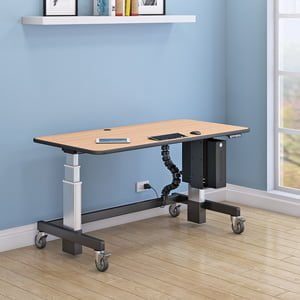
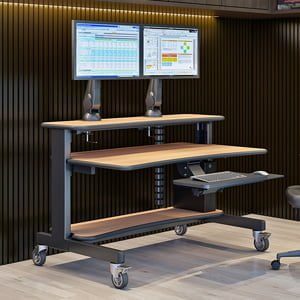
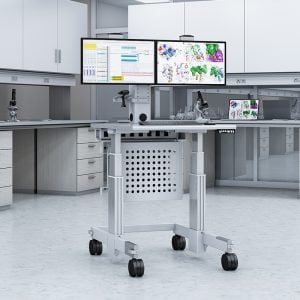
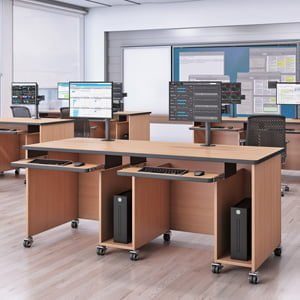
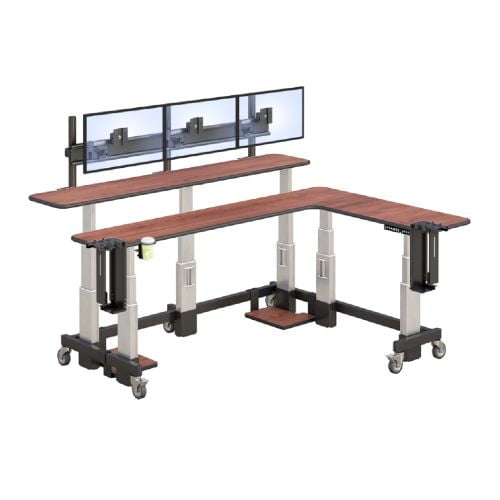
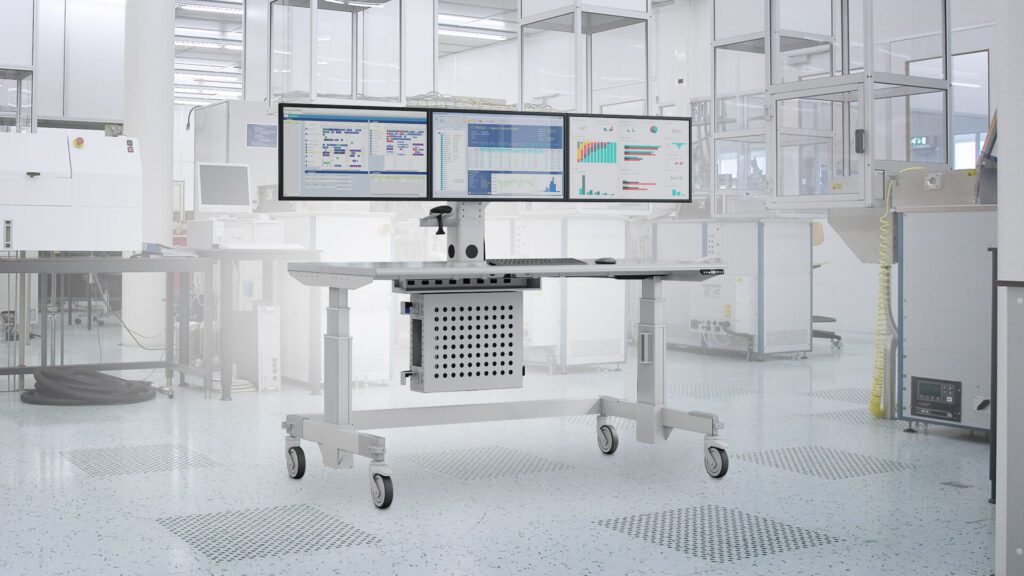
An electronic height-adjustable cleanroom workstation is the specific response to this specific tension. This article explains the ISO classification requirements that determine workstation specification, why electronic adjustment is the cleanroom-appropriate choice over manual adjustment, what a fully compliant cleanroom workstation includes, and how to match the specification to ISO class. The audience is pharmaceutical facility managers, cleanroom quality engineers, semiconductor operations managers, and procurement teams in regulated manufacturing environments.
| Quick Answer —An electronic height-adjustable cleanroom workstation offers three advantages over fixed-height and manual-adjustment alternatives: (1) the sealed electronic motor generates significantly fewer particles than a manual crank mechanism, making it appropriate for ISO 5 through ISO 8 environments where manual mechanisms are marginal or excluded; (2) the fully sealed housing is wipeable to the same standard as the work surface, satisfying cleanroom cleaning protocol requirements; (3) low-effort electronic adjustment is used more frequently by operators, realising the ergonomic benefit of position variation that manual adjustment discourages through physical effort. Specifications must be matched to ISO 14644-1 classification — see the AFC Industries cleanroom workstation range for ISO-class-appropriate configurations. |
Why Does Height Adjustability Matter Specifically in Cleanroom Environments?
Cleanroom operators in pharmaceutical manufacturing, semiconductor fabrication, and medical device assembly perform highly controlled, repetitive tasks over shifts of six to twelve hours. The precision required — visual inspection under magnification, manual manipulation of small components, pipetting, assembly of sterile product — demands both fine motor control and sustained visual attention. Both degrade with physical fatigue.
The physical fatigue mechanism in cleanroom environments is identical to the mechanism in radiology reading rooms and standard office environments: prolonged static posture without position variation accumulates musculoskeletal load, reduces cerebral blood flow relative to dynamic posture, and progressively impairs the cognitive and physical precision the task requires. The cleanroom context makes this more consequential than in most other environments because the tasks are more precision-sensitive and the shift lengths are often longer.
A 2018 study in the journal Applied Ergonomics found that pharmaceutical cleanroom operators performing repetitive precision tasks showed measurable increases in musculoskeletal discomfort scores and error rates in the second half of shifts compared to the first, with fixed-height workstation use as a significant contributing factor. The study found that workstation height adjustability — even without active position variation monitoring — significantly reduced end-of-shift discomfort scores and error rates.
The secondary advantage is multi-operator flexibility. Cleanroom workstations are often shared across shifts or across operator teams. In a fixed-height environment, the station is configured to a generic height that approximates the average operator but is wrong for everyone at the extremes. Height-adjustable workstations eliminate the ergonomic compromise for tall and short operators alike, which matters particularly in pharmaceutical and semiconductor facilities with diverse international workforces where the height range across the operator population can be substantial.
How Do Electronic Mechanisms Reduce Contamination Risk Compared to Manual Adjustment?
The contamination risk from a height adjustment mechanism in a cleanroom is real, specific, and often underestimated by buyers who haven’t encountered it in qualification.
A manual crank adjustment mechanism works through a gear drive. Every time the crank is operated, the gears mesh and generate wear particles from their contact surfaces. The type and quantity of particles depend on the gear material and lubricant. In most commercial manual height-adjustment mechanisms, the gears are steel or zinc alloy with a petroleum-based lubricant. In a cleanroom, petroleum-based lubricants are either excluded or tightly controlled. The gear wear produces metallic particles in the size range that is counted in ISO 14644-1 particle monitoring — typically 0.5μm and above. Regular use of a manual crank mechanism can measurably affect particle counts at the workstation level in ISO 6 and ISO 7 environments.
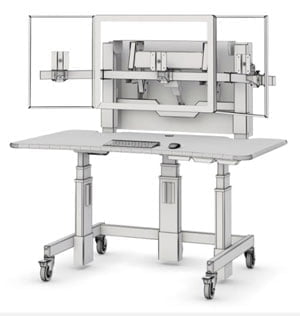
An electronic height adjustment mechanism has no exposed gear train. The motor drives the column through an enclosed lead screw or belt drive that is fully sealed within the column housing. There is no mechanism that is exposed to the cleanroom environment during adjustment or at rest. The sealed housing presents the same surface to the cleanroom as the rest of the workstation frame — smooth, wipeable, without recesses or lubricant exposure. Particle generation from the adjustment mechanism is effectively zero at the workstation surface level.
A second contamination advantage is cleanability. Manual crank mechanisms have housings with gaps and recesses around the crank shaft, adjustment indicator, and mechanism body. These gaps cannot be wiped to the same standard as a flat surface. They accumulate the residue from cleaning agents applied to adjacent surfaces, creating a contamination risk that grows with the frequency of cleaning. An electronic mechanism’s sealed housing has no equivalent gaps — it is cleaned by the same wipe protocol as the workstation surface with the same effectiveness.
The mechanism-level comparison is covered in more detail in the table below. For the full AFC Industries cleanroom workstation specification, see the cleanroom workstation product range.
| Factor | Manual Crank Adjustment | Electronic Height Adjustment |
| Particle generation | Crank mechanism and gears generate wear particles during adjustment; particle type and quantity depend on material and lubricant | Fully sealed motor and drive system; no exposed moving parts; significantly lower particle generation per adjustment cycle |
| Cleanability | Crank housing and mechanism are difficult to clean to the same standard as flat surfaces; harbours potential residue | No exposed mechanism; smooth sealed housing; fully wipeable to the same standard as the work surface |
| Adjustment frequency | Manual operation creates physical burden; operators make fewer adjustments to avoid the effort; ergonomic benefit is reduced in practice | Low-effort electronic operation; operators adjust more frequently; ergonomic benefit of position variation is more consistently realised |
| Qualification documentation | Mechanism wear is harder to document for IQ/OQ purposes; wear rate variable with operator use | Electronic mechanism provides consistent, documentable performance; motor function testable against specification at qualification |
| ISO class suitability | Acceptable for ISO 8; marginal for ISO 7; not recommended for ISO 6 or ISO 5 without extensive particle assessment | Appropriate for ISO 5 through ISO 8 with correct surface specification; preferred choice for ISO 6 and ISO 5 |
What Should a Fully Compliant Electronic Height-Adjustable Cleanroom Workstation Include?
A cleanroom workstation is a system of components that must each meet the classification requirements of the environment. No component that fails its specification can be compensated for by superior specification in another. The ISO class determines the minimum acceptable specification for every component.
The table below maps four ISO classes to their maximum particle counts, typical manufacturing environments, and the workstation specification implications for each. It is intended as a starting framework for specification decisions — specific facility requirements may be more stringent.
| ISO Class | Max Particles | Typical Environments | Workstation Specification Implications |
| ISO 8 | 100,000 particles ≥0.5μm per m³ | General pharmaceutical compounding; hospital pharmacies; some medical device assembly | Standard smooth-surface workstation with cleanroom-compatible casters; wipeable surfaces; no particle traps |
| ISO 7 | 10,000 particles ≥0.5μm per m³ | Pharmaceutical manufacturing support areas; sterile device assembly; biotechnology production | Sealed construction; no exposed fasteners; casters with sealed bearings; surface materials documented for cleaning agent compatibility |
| ISO 6 | 1,000 particles ≥0.5μm per m³ | High-purity pharmaceutical; semiconductor wafer preparation; optical component manufacturing | Non-outgassing materials; anti-static provisions where required; full surface cleanability documentation; IQ/OQ-compatible construction records |
| ISO 5 | 100 particles ≥0.5μm per m³ | Aseptic fill and finish; open sterile processing; critical semiconductor fabrication | Highest-grade cleanroom specification: electropolished steel or HDPE surfaces; anti-static dissipative materials; sealed motor on electronic adjustment; full material certification and outgassing test data |
How Do You Match a Cleanroom Workstation to Your ISO Classification?
Matching workstation specification to ISO class is a component-by-component process, not a single-dimension decision. Each component — work surface, frame material, adjustment mechanism, casters, electrical components — must individually meet the requirements of the target ISO class.
| Component Specification Checklist by ISO Class
Work surface material. ISO 8–7: smooth laminate or coated steel surfaces with no particle traps are acceptable. ISO 6–5: stainless steel (304 or 316) or HDPE surfaces with documented chemical compatibility with the specific cleaning agents used in the facility. For ISO 5 aseptic environments, electropolished stainless steel is the standard specification. Obtain material certification and cleaning agent compatibility documentation from the manufacturer. Frame material and construction. All ISO classes: sealed construction with no exposed fasteners on surfaces that face the cleanroom environment. ISO 6–5: fully welded or continuously sealed seams with no gaps or recesses. Powder-coated frames are acceptable for ISO 8–7; anodised aluminium or stainless steel for ISO 6–5. Verify that the coating is rated for the cleaning agents used — some cleanroom disinfectants degrade standard powder coat. Height adjustment mechanism. ISO 8: manual crank acceptable with particle assessment. ISO 7: electronic preferred; manual requires documented particle data. ISO 6 and ISO 5: electronic sealed mechanism required; manual mechanisms generate unacceptable particle counts at these classifications. Casters. All ISO classes: sealed bearing casters rated for the specific cleanroom floor surface. For ISO 7 and above: conductive or ESD-dissipative casters where anti-static requirements apply. Verify caster compound is compatible with cleanroom floor cleaning agents. Caster bearing seals should be documented as cleanroom-appropriate, not generic ‘sealed’ bearing specification. Electrical components. All ISO classes: no exposed wiring or connections on surfaces facing the cleanroom. ISO 6–5: all electrical components in sealed housings with IP ratings appropriate to the cleaning method (spray cleaning requires higher IP rating than wipe-down). Verify that cable management channels are fully sealed and wipeable. Qualification documentation. For pharmaceutical and medical device environments requiring IQ/OQ/PQ validation: obtain construction records, material certifications, cleaning agent compatibility data, and electronic mechanism performance specifications from the manufacturer at the time of purchase. Retrospective documentation requests are frequently incomplete and delay qualification. This documentation is the difference between a workstation that qualifies in the first cycle and one that requires multiple remediation rounds. |
AFC Industries’ electronic height-adjustable cleanroom workstations are available with ISO class-specific surface, frame, caster, and mechanism specifications, with material certifications and IQ/OQ/PQ-compatible construction documentation as standard. Contact the AFC Industries team with your ISO class, cleaning agent protocol, and qualification requirements to discuss the specification that meets your facility’s standards.
The Two Problems This Workstation Solves Simultaneously
The electronic height-adjustable cleanroom workstation exists because fixed-height cleanroom furniture and standard ergonomic workstations each solve only one of the two problems a cleanroom operator faces. Fixed-height cleanroom furniture meets the contamination control requirement and ignores the ergonomic one. Standard ergonomic workstations meet the ergonomic requirement and fail the contamination control one.
Getting both right simultaneously requires a workstation designed from the start for both constraints: sealed electronic mechanisms that meet ISO particle requirements, surfaces that survive the cleaning protocol, casters specified for the floor and the classification, and construction documented for IQ/OQ qualification. The specification work is front-loaded — it happens before purchase, not during qualification — and it is what separates a cleanroom workstation that qualifies on first cycle from one that generates remediation findings.
For facilities in regulated environments, the cost of an underspecified workstation is not just the purchase price of the wrong product. It is the qualification delay, the remediation cost, and the operational disruption of removing and replacing equipment in a controlled environment. Specifying correctly from the start is significantly cheaper than the alternative.